Showing posts with label Lamentations of the Flame Princess. Show all posts

Wednesday, 7 December 2016

Mini Review: Broodmother Skyfortress


Broodmother Skyfortress

Author: Jeff Rients
Publisher: Lamentations of the Flame Princess
Buy: PDF // Book + PDF Combo

TL;DR: 

*Buy this if you like your fantasy à la Jack Vance weirdness and like lots of tables and GM advice.

*Do not buy this if elephant/shark combos are too weird for your boring elves & dwarves setting.

Overview:

Basically a big, floating, cloudy fortress that was created by some gods/other insanely powerful beings but is now inhabited by dumb Shark/Elephant monstaz who wreak havoc on your campaign world; they're powerful and will probably kill everyone, but why not visit anyway?

The latter half is dedicated to reproducing 'best of's from Jeff's blog. These are mainly random tables and GM advice, which in sum is solid. 

Thoughts:

I had a bit of publisher credit on DrivethruRPG so I bought this because I liked the look of it and was not immune to the G+ hypemachine (though I have been strangely ambivalent lately). I've been playing a lot recently (OD&D, Warriors of the Red Planet/Numenera, Tombstone, Savage Worlds Fallout), but not writing a lot on here, mainly because I haven't been that inspired and also because I have a shit-ton of academic writing to complete; but this book forced me from my blogging-hibernation.

Serendipitously, this 'adventure' – while excellent in its own right – may be one of the very best Game Master how-to introductions on the market. It is very simply presented, is immensely user-friendly and conversational, even funny at times, and is filled with encouraging exhortations for the new Game Master. You won't find arduous theoretical pontifications on the three conceptual pillars of role-playing adventure, or platitudinous advice for 'storytellers' here. Instead, there is simple (sometimes single sentence) advice that is not only concrete but practical. This part of the work is stellar.

There are also plenty of interesting adventure options. One dubiousness I felt before reading through it was whether the shark/elephant thing was just being weird for the sake of it – as in 'hey, wouldn't it be cool if like, there were these shark-headed elephant giant dudes, and whoa, wouldn't that be super creative and original?' – and therefore a bit kitsch (not in a good way). The answer to that is 'no: it is not kitsch'. The whole conceit of the background has been well integrated and is logical albeit bizarre (in a good way). It kind of reminds me of Jack Vance weirdness. Fucking strange to the point of being comical, but weirdly makes sense. Besides, Rients offers advice to re-skin the monsters, presenting some interesting counter-ideas. By the end of it, however, I was pretty enthralled with the original premise and would definitely run it that way if I ever get the chance.

I like that it would fit pretty well with the flavour/weirdness of my OD&D campaign. The other thing I like about it is it goes beyond the rote 'this-is-how-to-run-my-adventure' thing that a lot of products do and encourages the reader to get their hands dirty and make the thing work for them. While this is not at all anomalous of OSR products generally, I find that sometimes the sparseness or ambiguity of certain products breeds equal frustration as to being overwhelmed with a wall of text: what do I do with this? Thankfully, Broodmother Skyfortress takes a very pleasing middle-ground. The prose does not get bogged down in minutia, but instead relates all the pertinent facts and even additional options, then gets out of the way. The artwork and layout cannot be faulted: I really dig it.

Conclusion:
All in all, this is one of the better adventure/supplements on the RPG market currently. Publisher James Raggi's sales blurb claims:

"Since the invention of the adventure module, there have only been five adventures that were rated the most awesome...Broodmother Sky Fortress leaves them all behind.Your game won’t suck anymore! Broodmother SkyFortress: Buying any other adventure is just throwing your money away."

Although obviously being cheeky, I don't actually think he is too far off the mark: (1) Broodmother Skyfortress is very awesome; (2) Your game will certainly improve if you use Rient's advice; (3) if we are making comparisons here, buying other adventures opens the door to the very real possibility of being disappointed – it is that good.

This is probably my first review where I don't have any critiques. What's more is that I want to run this thing immediately, pretty much as written: that is always my internal barometer of whether a product is any good. Many plant seeds of ideas, but few inspire me to follow them more or less as written: this is both due to the time it takes to digest someone else's work and the often potentiality, though not the execution, of interesting ideas that could be taken further. This adventure – let's just call it a supplement – surpasses all those caveats. Have I said it is good? 


Tuesday, 21 July 2015

Dark Albion: The Rose War — Review


Author: RPGPundit/Dominique Crouzet
Price: $9.95/$29.24 (RPGNOW/Lulu)

Format: PDF/Print
Page count: 285
System: DOM Publishing/Fantastic Heroes & Witchery (OSR compatible)
Year: 2015


Dark Albion/RPGPundit - Corey Ryan Walden Review


This review is long. If you don't want to read the whole thing, I suggest you scroll down to the "Final Thoughts" section. Adieu. 

When I was a young boy I loved pirates. On one occasion my mother took me to the public library. The library were getting rid of their old books, stacked on two trolleys in a concrete hallway. Most were falling apart. Some were horribly old, covered in sweat, stains, and the smells of antiquity. The grotesque primeordialism of them offended my youth. But my mum bought me a book about pirates: Pirates of the Spanish Maine, by Hamilton Cochran. The book was teeming with artwork: a mismatched medley of paintings, black & white sketches, illustrations, even some photos of recovered treasure. The book was falling apart, but I loved that thing: it recalled an era forever obfuscated to me, but accessible through a literary veneer. That realisation somehow stuck with me throughout my life, and is probably why I immediately fell in love with Dungeons & Dragons. The power of literature and art, is in its ability to transport a person to another reality. I believe Pirates of the Spanish Maine is still at my parents house, in a box somewhere. Dark Albion: The Rose War reminds me of this book. Dark Albion is a new book, but it feels convincingly old. I feel like I've stepped inside a history book; except a history that is not our own. Or rather, it is our history if we lived in a dark alternate reality. So what is Dark Albion?

Excerpted from the introduction of Dark Albion:

Dark Albion/RPGPundit - Corey Ryan Walden Review
RPGPundit describes the book as being initially inspired by Game of Thrones, with a bit of Lamentations of the Flame Princess thrown into the mix. Dark Albion is an obvious departure from these influences however, depicting its fantasy as "sinister", "dark", and "gritty". These are terms that everyone bandies around in the OSR, and ironically in the attempts to remove the Tolkienesque tropes from our games, I fear these words have become their own fantasy cliche. With that contention out of the way, I wanted to see how Dark Albion holds up; not only in regard to its tonal claim, but as a complete product. 

First Impressions:
Dark Albion is impressive. The digital download was PACKED with content. I actually laughed in amazement at the amount of content. It's ridiculous. Want an example? There are seventeen (17) digital maps, irrespective of the 285 pages in the Dark Albion book! Some I liked more than others (which I'll talk about later), but the amount of work that has gone into this project is nothing to sneer at. Quite the opposite. 

Generally speaking, I do not like public domain artwork in RPG products. I find it detractive, rather than helpful. Dark Albion is the one exception where public domain artwork is not only appropriate, but effective. It is meant to have this type of artwork. As I mentioned in my introduction, it recalls an old reference work, while being completely new. The layout reminds me somewhat of Rules Cyclopedia. If you like RC I imagine you'll find the interior layout to your liking. 

Dark Albion's unswerving commitment to detail truly staggered me. Some RPG supplements are evocative and original, yet are lacking in overall substance. Honestly — and I say this without any sense of hyperbole — Dark Albion may be the most thorough and detailed RPG product I have ever read. The alternate history it presents is so considered and integrated I had trouble working out the subtler differences between history and fiction at times. RPGPundit writes well. He writes in a way that does not talk down to, or coddle his audience, yet delivers the message with clarity and punch. I'm not sure what his academic career entails as an historian, but I found the work to be logical, succinct, and cumulative in its presentation; as a good history source should be. In short, I really enjoyed his style. 

With my initial reactions out of the way, let's look at some specifics.


The Specifics: 
Layout: The interior of Dark Albion is black & white. It's a common choice, making publishing a lot cheaper. Given the content and overall mood of Dark Albion I think this was a perfectly suitable choice. Dominique Crouzet works as a graphic artist, I believe, and has added his talents to Dark Albion's cartography, cover design, border art, and layout. The border art is attractive and fitting for this work.The table of contents and index are clear and relatively comprehensive, making navigating the book a breeze. Page [b] uses an unattractive font, appearing muddy on my computer. It appears to be the only place in the book where this font is present. A simple and legible font is used everywhere else.

Total: 4/5

Maps: I love maps. As far as I'm concerned, the more the merrier. The good folks responsible for Dark Albion clearly align with this philosophy too, given the impressive amount of cartography. Naturally, some maps are better than others, though they are all very functional. I immediately gravitated towards the Player Maps. They have an attractive sepia/parchment appearance, providing a thematic complement to the entire work (see below).

Dark Albion/RPGPundit - Corey Ryan Walden Review Maps
I found the Albion colour map to be lurid. I wasn't a fan of the colour choices, which are too bright. I felt it diminished the otherwise consistent black & white theme (see below).

Dark Albion/RPGPundit - Corey Ryan Walden Review Maps

The hex maps are decent. They're tidy and gameable (see below). 

Dark Albion/RPGPundit - Corey Ryan Walden Review Maps
Lastly, the adventure maps are very good — clean and pleasing to the eye. There were some noticeable visual inconsistencies between sets of maps, and a few of the maps looked a little cheap to me. But again, a huge applause for the efforts and attention to detail. I can't even imagine how long they would have taken to create. For any fellow pedants, simply use the maps you like, and ignore the rest. I'm not certain, but I would estimate there are more than 25 maps if you include those within the book! 

Total: 3.5/5

Artwork: The artwork is almost entirely public domain, and all of the curated pieces match the tone of the work. There are usually at least 2 pieces of artwork per page. The book looks good to read through, though if you are skimming through the book, or reading it for elongated periods of time, it becomes somewhat tedious to look at. Artistic highlights were the castle pictures, the absolutely terrifying demon illustrations, and some of the battle scenes. 

Dark Albion/RPGPundit - Corey Ryan Walden Review Art
Again, like the maps, this is all highly subjective, so if you're big on public domain artwork I bet you'll really like the look.

Total 3.5/5

Content: Buy this book for the content. I don't care what anyone says about Dark Albion, the complete commitment to detail, and the immense volume of work is worthy of commendation. Seriously — and I cannot stress this enough — it is absolutely excellent. Whether or not I would use everything in Dark Albion is besides the point. If you've read any of my previous reviews, you'll know I'm a pick-and-choose kind of guy. I'll outline some of my personal highlights. Situated in modern-day France, Frogland  is the home of repugnant worshippers of "dark alien gods". The idea has a sense of primordial fear to it, in some senses reflective of the English/French relationship historically. Besides the obvious analogs between the French and the Frogs, I like the idea of a land in close proximity, where fear of attack from monstrous fiends is every looming. Sure, it's been done before, but it adds some political tension to the game, and is a great adventure hook for further development.  The Eire is another attractive adventure site, filled with "barbarians and dark fae". The land is described as pagan, and provides an interesting point of tension to develop. The Cymri are a race of men, who had ancient dealings with elves. They were possessors of powerful magic, and consequently a new class, the Cymric bard, has been developed as a playable option. 

Speaking of new options, there are plenty within Dark Albion. A range of new classes are presented including the Cymric bard, demonurgist, hedge witch, magister, noble knight, knight-errant, and more. Mechanically there are numerous suggestions for running a game in the Dark Albion universe, both for common retroclones like Swords & Wizardry and Lamentations, but also for Fantastic Heroes and Witchery. Additionally, RPGPundit has included his "Quick and dirty house rule notes", which include some excellent suggestions for beginning an Albion campaign. The treatment of demons is most terrifying. Demon summoning, dark magic, and fearful sorceries are described in detail, living up to claims of "dark and gritty". 

I counted eight adventure sites/mini adventures within Dark Albion. My favourite were the Barrowmound adventures, which had the best of the adventure maps (I thought). Rules for law, punishment, and justice are included within Dark Albion, adding to the punitive feeling of any good medieval/early renaissance work. Dark Albion is packed with detailed setting information, including heraldry, important political figures, quasi-historical timelines, battles, name generators, cosmologies, description of the low magic setting, and much more. I could go on, but you get the idea. This tome is oozing content. 

Not only is Dark Albion extensively detailed, but it is highly useable. Pains have been taken to give the DM/Ref plenty of suggestions for incorporating material into their campaigns. New mechanics are well-covered, and the setting information is purposely broad, allowing the DM to get his/her hands dirty, and make Dark Albion their own. 


Total: 5/5

Final Thoughts:
No one with a firm grasp on their sanity would dispute the staggering amount of work that has gone into this product. That the work is impressive and comprehensive is beyond an understatement. There is no half-assery here. Blood, sweat, and tears have been poured into Dark Albion, making it an 100% effort. It is easy to cut corners when quality, literary consistency, and excellence are concerned, but no such liberties have been taken in Dark Albion. With maps for days, 285 words of useful content, and all the artwork you could possibly want, Dark Albion delivers on its promises, and more.

That said, I have a few gripes here and there. The overall inconsistency of public domain artwork rears its ugly head at times. It was no mistake to use public domain artwork in Dark Albion. It certainly fits the mood. The inevitable and fundamental problem I have with public domain still stands however — it can look great, or it can look somewhat thrown together, as so many varying artists are required to fill out a project. This gives the work a patchy feel at times. I readily admit my biased behaviour to judge a book by its cover, but first impressions stick. The same can be said about the maps. Sometimes an overall theme seemed to be lacking: one was colourful, one set was parchment, one set was greyscale. I think this was to clearly distinguish between player maps, geographical map, and area maps, but the effect was a little jarring or inconsistent. 

My personal predilections aside, Dark Albion is a book rife with possibility. If one has been searching long and hard for a quasi-historical, low-magic setting, filled with all manner of the grim and horrible, look no further. Dark Albion delivers in that department beautifully. It combines standard fantasy tropes, history, and folklore so well, that one begins to question where one ends, and the other begins. It is a truly mythological work, endowed with a sense of otherworldly epic. I have not played a campaign using Dark Albion, so I cannot comment on its pragmatic application. I am left with a sense of possibility, however, as the cogs of inspiration begin to turn. 


Total: 16/20

Thursday, 16 April 2015

Give a man a monster, and he'll game for one day; teach a man to create a monster, and he shall game forever.

My facetious take on an old proverb may be irreverent but it's true. I have in my collection tomes upon tomes, filled with monsters. My collection begins with the monsters presented in the 3 little brown booklets of Original Dungeons & Dragons. Add in the supplements like Greyhawk and Blackmooor and it's beginning to feel like Advanced Dungeons & Dragons. But why stop there? There is the Basic and Expert box set by Tom Moldvay and David Cook. There are real some goodies within, and of course we must not forget the aforementioned AD&D monster manuals. For good measure I also have the OSRIC rulebook and the Astonishing Swordsmen & Sorcerers of Hyperborea box set (both being representative of the content emerging from the OSR). Both of these present unique monsters, drawn from fandom or from the pages of Lovecraftian et al, tales. The 2nd edition Monstrous Manual sits next to them on my shelf, and again, is filled with a menagerie of options. I gave away my 3rd edition books some time ago, but again, we have similar monsters represented therein, and some different. I skipped 4th edition entirely, so cannot comment on that. Finally my 5th edition Monster Manual contains some of the classics we've all grown to love. I could throw in the adventures and other supplements I own: boxsets, modules, and my recently acquired Lamentations of the Flame Princess products (Carcosa, Isle of the Unknown, A Red & Pleasant Land). At this point you may be begging me to stop; and I shall.

These are all resources at my disposal, yet I'm inevitably drawn to my own imaginings when it comes to the various underworld (or wilderness) horrors appearing in my games. Don't get me wrong, I liberally borrow from the manuals I own, but when constructing my campaigns my position is always 'flavour first'. In many respects the system one plays is irrelevant, so long as it works for those at the table. The Internet is proof there is no definitive answer as to which system is inherently 'better'. Forums, blogs, websites, videos, and so on, are filled with nerd-raged fans proselytising the virtues of their edition of choice. At least it cannot be said of this subculture that we are passionless people. So play whatever you want, and be sure to have fun. The issue remains however, if whatever is being run is not working for you in your role as the DM. Nearly two years ago I started writing a Pathfinder campaign (which has concluded recently). My biggest frustration with that particular system was that it took so damn long to stat everything out. It interrupted my workflow and creativity. 'I would continue writing, but I need to work out NPC X's skill distribution'. Yeah. Not fun. Inevitably too, the flavour of the game was imposed by the ruleset I was using: I wanted a low magic, and somewhat underpowered campaign, yet mechanically and aesthetically this was a real stumbling block. In my opinion I ultimately failed in my mission, but you'd have to ask my players their opinion on the matter. Sure we had a good time, but it wasn't quite what I was attempting to achieve. The system got in the way.

The draw of simpler systems, whereby one can compose a stat block within 5 minutes has some real appeal in comparison. I can conceive of a monster, think 'damn that's awesome', and have it on paper within a very short duration. I can then continue my debased preparations, cackling occasionally as I scheme of the various horrors soon to be assailing my adventurers. Dungeons & Dragons from the outset, it seems to me, has always been about creativity and freedom. Creativity to conceive fantasy worlds of one's own devising, and to inhabit it with people and creatures. Imagine fiefdoms and baronies, or a race of alien overlords who enslave humanity for their own unknowable agendas. The geography is up for negotiation. Want a mountain here? Sure. This is a cave inhabited by men who farm giant worms? Sure. Even the physics and laws we must obey on Earth can be bypassed, manipulated or even ignored. Planets exist only as they're needed, or a campaign can exist purely within a flat-earth concept. Magic enables planar travel, invisibility and ultra-healing where in our world we say 'impossible!' The freedom within D&D, comes from exploring these worlds. A bank teller, an IT expert, a CEO and a taxi driver can set aside their 'mundane' identities for a few hours and be something they never were/are in reality, yet somehow represents them in an uncanny way.

Which brings me back to where we started: our rulebooks, our supplements, the products we purchase and the dice we use should be subservient to us. They are there to inspire, to motivate and enable our games as we envision them. They are not there to become a burden or a blockage to what we are trying to achieve. TSR's slogan used to be 'Products of your Imagination'. In other words, the system should disappear into the background, as your imagination gives birth to, and takes precedence over, your collective gaming experiences.

So go... Find a system that is effective in design and implementation, and enabling of the flexibility you need. Imagine those monsters, create those worlds, and you too shall game forever young grasshopper.

Monday, 13 April 2015

Carcosa Expanded Edition - Lamentations of the Flame Princess

Carcosa - Lamentations of the Flame Princess, RPG, Geoffrey McKinney, Review
Author: Geoffrey McKinney
Price: $37.95 (From Noble Knight Games)
Format: Print + PDF
Page count: 275
System: Lamentations of the Flame Princess (implied)
Year: 2011

Note: This post contains content that some may be sensitive to. Please be advised. 

Geoffrey McKinney's Carcosa caused a stir when it was first released in 2008 (self published). Clearly situating itself within the Original Dungeons & Dragons paradigm, Carcosa referred to itself as 'Supplement V'. It was the aspects of Carcosa's content more than anything, that caused the controversy. Whether or not this reception was founded, I will leave up to the reader's discretion. I am of the opinion that censorship need only exist in the format of a warning (which is exactly what this product comes with), thereafter the consumer should be able to make an informed decision of the product's merits or shortcomings. That being said, I can completely understand why some felt the way they did about this product, as quite clearly this text falls well outside the realms of 'normal' Dungeons & Dragons. The version that I am reviewing is the Expanded Edition published and released by Lamentations of the Flame Princess.

The Good
This book comes with a warning: 'For Adults Only!' Like many Lamentations of the Flame Princess products, there is no intention to pander to generic tropes of fantasy role-playing, and in my opinion this is the real strength of the publisher: they are willing to push the envelope of what D&D can be. Like any good art, this is a necessity. Role-playing games are a 'creative' endeavour, thus I do believe the hobby requires artistic integrity for continued development. This is particularly necessary to avoid stagnation (though of course there are appropriate ways to achieve this goal).

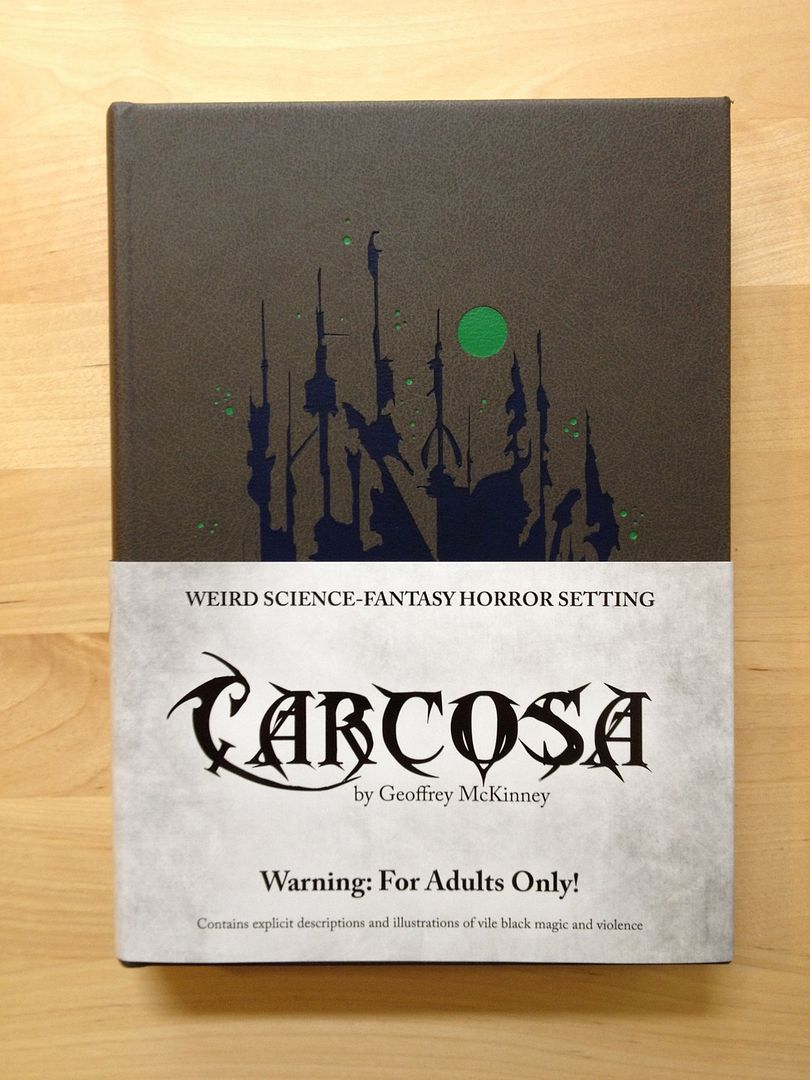
The cover and binding of Carcosa is elegant. It is a soft faux-leather/material and is very aesthetically pleasing. It contains an enigmatic illustration of a watery city, spired and illumined with a green moon-like orb, and clusters of green star-like dots. The artwork reminds me strongly of the old pulp tales, though stylistically it is dissimilar. It is the intrigue of the illustration that emanates a distinctly pulpy aura. It is successfully mysterious. The back of the book has neither illustration nor words, and the spine presents only a curious symbol, similar stylistically to the cover illustration. Both cover and spine are devoid of words or title, thus the reader is forced to open the pages to extract the book's identity. It is reminiscent of Lovecraft's Necromonicon and is extremely thematic to the text - being a grimoire of forbidden knowledge. 


Carcosa Extended Edition Map - LotFP Geoffrey McKinney RPG
Lurid purple maps are within the front and back covers: one is of Carcosa's overland geography, the other details one particular hex. While bright and flamboyant they again dwell securely within the palette of the book, following the green, purple and black colour scheme. The maps are a big improvement (in my opinion) to those featured in Isle of the Unknown, both in clarity, thematics and practicality. I like them. 

The other illustrations within the book vary from intriguing to somewhat repulsive. One image in particular I find hard to look at: it depicts a vat of naked humans, bearing expressions of both misery and fear on their faces. They are being ignored by a stern sorcerer intent on sacrificing them, and a prodigious entity above him to whom he makes the sacrifices (see below).


 Carcosa - Lamentations of the Flame Princess Geoffrey McKinney Illustration Inside
Others illustrations depict monstrous beings, fight scenes between denizens, prodigious cauldrons filled with strange substances, dinosaurs, aliens and technology, fungus and weird structures. In sum the artwork is very well executed, save for that one image that is personally too much for me. The layout, like most Lamentations of the Flame Princess products is exceptional. I value the precision of the font size, and the sparseness of words on each page. It reads more like a guide and less like a scholastic textbook, as other RPG products are wont to do.

Besides appearances, the content is consistently creative. I find it a marked improvement over Isle of the Unknown, resulting in a clearer, cohesive, and more considered work. The introduction makes it transparent to the reader that 'Carcosa is not Tolkien, high fantasy, or mainstream fantasy'. Good! The literary inspirations are crystalline, citing Lovecraft, Howard, Carter and Moorcock. The book continues with dice conventions. Carcosa departs markedly from conventional D&D (or whatever you're running) as far as dice rolling is considered. Instead, monster and PC hit die vary encounter to encounter, as does the amount of damage one deals. Handfuls of dice are rolled, rather than the few one may normally utilise within a game. There are tables for measuring this, and the mechanics are fairly clear (if slightly superfluous). I asked Geoffrey about the rationale for this mechanic recently on Dragonsfoot. His explanation was that he had purchased a large quantity of dice and needed to create a mechanic to use them. As they say, 'necessity is the mother of invention'. I'm unsure at this stage whether I would use this approach, but thinking about it, it could add some uncertainty and ambiguity to match the theme of the setting's hellish and esoteric landscapes. Characters within Carcosa may only be fighters and specialists (similar to a thief), and a new class: the sorcerer. The latter can fight in armour and utilise weaponry as a fighter, but have access to the hideous rituals within this tome. 

The psionics system within Carcosa is simple and effective, though I personally would increase the % chances for characters to potentially possess these abilities. Besides this minor nitpick I prefer McKinney's implementation above other systems I've seen. Following the psionics section, other aspects of Carcosa are detailed, such as lotus plants and their effects, various technologies of enigmatic purpose, and an adventure 'Fungoid Gardens of the Bone Sorcerer'. Sorcerous rituals are detailed within this book too, and generally require an ingredient that must be gathered from a certain hex, and most require the sacrifice of human beings. These types of entries - the sacrifice, the worship of appalling entities, and the overall mistreatment of humanity was where much of the controversy stemmed. I can see why, as again, some people veer well away from these themes. My own games can be pretty macabre, but these descriptions were occasionally off-putting. At times I did feel squeamish reading through some of the ritual descriptions.


Carcosa - Lamentations of the Flame Princess Geoffrey McKinney Illustration Inside
The monsters are clear and inventive. There was nothing out of place or tacky about the monsters (unlike Isle of the Unknown). I would definitely use them within my games. The hex descriptions contain two points of interest. For those running a hex crawl these points of interest are exactly that: interesting. Again I must make a comparison to Isle of the Unknown where many of the hexes were essentially useless, rendering a hex crawl therein nigh impossible without some serious intervention. Hexes detailed in Carcosa are much more compelling. It makes me want to run an adventure or two in Carcosa immediately. You can literally conduct a hex crawl with this product. The end portion of the book describes 'humanity on Carcosa' in addition to tables, mutations and a robot generator. All good stuff.  

The Bad
While there weren't any significant shortcomings to this work, I do feel like the sorcerous rituals became somewhat repetitive. Yes, okay, we need to sacrifice some green men, or yes, we need to find some maidens and slaughter them between a black stone, etc. I find this overall repetition recurrent within McKinney's work - one idea is hashed and rehashed repetitively. In Isle of the Unknown the repetition was that 'everything is unique' (until nothing is unique), in Carcosa it's that 'everyone is really wicked, worships loathsome entities, and people get sacrificed a lot'. I found this repetition to be far more digestible in the current work because it fit the overall theme. It was without the kitschiness Isle of the Unknown possesses. Carcosa is very inventive and compelling. McKinney should be proud. As I mentioned above, one particular illustration bothered me, but the warning on the cover is very explicit about the contents being explicit. I knew what I was getting myself into. Please let me be clear that this work is DEFINITELY NOT for some gamers. If you're into high fantasy, with elves, dwarves, halflings and gnomes living in basic harmony, replete with very obvious baddies and goodies this work may leave you reeling; no one is 'good' in Carcosa. Some of the themes and descriptions are pretty dark. In Carcosa Drizzt will think the Underdark was a vacation, Elminster will be devoured by the Old Ones and Tasslehoff will suffer a long and grizzly death, hopefully along with the rest of his kind (can you use Kender for these rituals?). 

Final Thoughts
Overall Carcosa is a commendable effort. McKinney's writing and creativity is noteworthy in this volume, while Lamentations of the Flame Princess' exceptional production values make this book a truly visceral experience. If the content of this review appeals to you thus far I would recommend its purchase. If you're bored by generic D&D fantasy, you'll probably find this work much to your liking. Conversely this tome is not for the faint-of-heart. It does contain horrific themes, and as such, may be off-putting to some. 

On Gygaxian Dungeons

AD&D Dungeon Masters Guide Gary Gygax Dungeon Gygaxian
Gary Gygax's Advanced Dungeons & Dragons: Dungeon Masters Guide, published in 1979, is iconic. It's iconic for myriad reasons: it is quixotic and somehow practical both, it contains admixtures of advise, mathematics, statistics, tables and herblore, information on monsters and gems, the passage of time, combat in strange places, details of magic items, consulting sages, hiring hirelings, avoiding assassins, and examples of play. In other words, a list galore with more than I can possibly manage in these posts. One aspect, and one that I feel is frequently overlooked is the random generation of dungeons. Those of us with adequate imagination and intellect can construct reasonable or even commendable underworlds, caverns, and dungeons, aimed at keeping our players on their toes. But where imagination is sometimes exhausted, the quirks of chance can be of assistance.

Lately, or rather within the past month or so, I have been relishing the generation of dungeons in this random vein. I begin with a piece of paper. Opening my Dungeon Masters Guide to Appendix A: Random Dungeon Generation (pg. 169) I scrawl down one of the five possible examples for starting areas within a dungeon. Gygax advises to begin this process in the middle of a page, though for some unknown reason I prefer the bottom of the page. With a single d20 and a few other assorted dice, one can create some very interesting dungeons. I find this method provides an excellent springboard: it gets you going, then imagination often takes over. You can follow it by the book, or pick and choose features you think are fun. I find this method best when I have a vague notion of what may lie within these underscapes, but without exacting preconceptions. This process inevitably creates some intriguing results. The sizes and shapes of rooms seem to vary notably, along with the angles of passageways, and features both natural and manmade. Treasure, traps and monsters can be randomly generated too, and again, the results are often unpredicted. One can determine the number of exits, and on what walls the doorways are located. Caves, caverns, pools and even stairs are covered too. Finish your dungeons using Appendix I: Dungeon Dressing to add both mundane artefacts and 'unexplained sounds and weird noises' to your dungeons.

I don't care what edition you play, this process makes for some great dungeon ecology. Two recent examples have borne satisfying results. Some of you may remember the Original Dungeons & Dragons one-shot I ran some weeks ago. This dungeon was completely Gygaxian generated (though I confess, I did add a few things, or tweak a result to make more sense within the context of the adventure). I only had one prerequisite: I wanted a large underground lake. The second example is an Astonishing Swordsmen & Sorcerers of Hyperborea adventure I've been labouring away at for the past couple of months. The final level of the adventure was roughly 50% constructed using the random dungeon generation method, though in this instance I was fairly liberal with my interpretation and amendments: I need it to make sense. For this latter example I had an internal checklist of things I needed to include on this level, and the combination of random and purposeful worked well.

If you've never tried this method all you need is Gygax's Dungeons Masters Guide, a set of polyhedral dice, and a pen and paper. Conceivably you could conduct limitless campaigns with just this tool and the application of some imagination. If you are new to old school D&D, or you have simply never seen or used this resource I highly recommend it. Wizards of the Coast reprinted this book in 2013 (I think it was then), thus a new copy can be acquired reasonably cheaply. Alternatively pick up an old copy for $5-10 on Ebay. In my opinion it is a systemless tool - thus whether you are playing AD&D, Labyrinth Lord, Lamentations of the Flame Princess or 5th Edition D&D, you'll find something to assist with the construction of your underworlds. As always: happy gaming!


Thursday, 9 April 2015

A Red & Pleasant Land + Isle of the Unknown (Double Review)

I have a double review for you today.

After not buying anything from Lamentations of the Flame Princess, ever, but repeatedly hearing things* about the brand I decided the time was impending for me to taste of the fruit. Today was a good day because... *drum roll*

...this arrived!


A Red & Pleasant Land Review, Zak Smith, Lamentations of the Flame Princess, Isle of the Unknown, Geoffrey McKinney, Corey Ryan Walden

But what's in the box?


A Red & Pleasant Land Review, Zak Smith, Lamentations of the Flame Princess, Isle of the Unknown, Geoffrey McKinney, Corey Ryan Walden

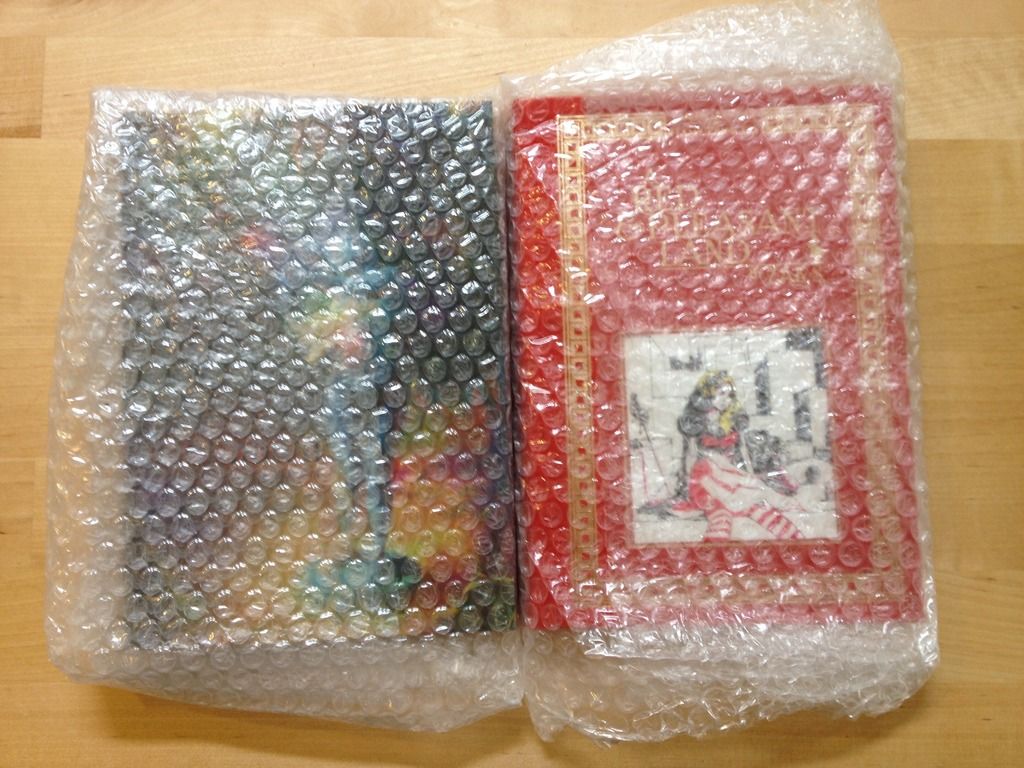
When the bubble wrap was removed, this is what I saw:


A Red & Pleasant Land Review, Zak Smith, Lamentations of the Flame Princess, Isle of the Unknown, Geoffrey McKinney, Corey Ryan Walden

Yes, those of astute disposition will surely recognise A Red & Pleasant Land by Zak S., alongside Geoffrey McKinney's Isle of the Unknown. I have had my eye (or consciousness) on McKinney's Carcosa for awhile too, and finally put in an order from Noble Knight Games. James Raggi (owner of LotFP) got these pictured books sent off quickly, beating my Noble Knight order to arrive, even though Carcosa was ordered a week or so before these books! For the record, James will also honour customers with a free PDF download copy of any LotFP book you have purchased in the past, provided you can produce some proof of purchase. Consequently I have been reading through these three books via PDF before they even landed on the fair shores of New Zealand, and already have a good notion of their contents. Although I digress, I have found LotFP to be a good company to deal with thus far, both in speed of delivery and my personal dealings with Mr Raggi. Tick that box.

First things first. These products make some presumptions, namely that:

A) you'll be using their system Lamentations of the Flame Princess - Weird Fantasy Role-Playing, which seems fairly similar to OD&D/Basic. 

B) that you're not a G or PG rated kind of player, and don't mind a bit of madness/darkness in your games.

The first is certainly not a deal breaker. Any gamer with any knowledge of role-playing games should have no difficulty translating these products to their game of choice. The second is much harder to get around, you either like an M or 18+ style of gaming or you do not. Having said that, if one opens their mind a little, and actually digs into these products, you'll certainly find inspiration in abundance. And of course, not all of it, nor even the majority of the content is that extreme. That Raggi has been rather successful as a publisher suggests there is a market for it, and alongside Astonishing Swordsmen & Sorcerers of Hyperborea provides a niche of gaming I personally really enjoy. 

A Red & Pleasant Land:


A Red & Pleasant Land Review, Zak Smith, Lamentations of the Flame Princess, Isle of the Unknown, Geoffrey McKinney, Corey Ryan Walden, Dungeons & Dragons
Author/Artist: Zak S.
Price: 35.75€
Format: Print + PDF
Page count: 187
System: Lamentations of the Flame Princess (implied)
Year: 2014

The Good
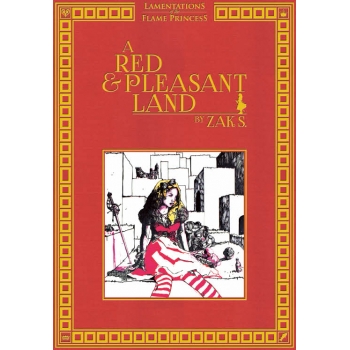
An old adage goes something like 'don't judge a book by its cover', yet that is what we inevitably do. I guess that's as good a place to start as any, thus I will. The cover reminds me of a novel from the 19th or early 20th century - reminiscent of a Charles Dickens volume, or a novella you may expect to find in an antiquated bookstore. The difference being it is very 'new' looking, and is extremely vibrant. It is red (surprise!), and embossed with gold. Sitting on one's bookshelf, it would be indistinguishable as an RPG product, and I like that; it's very thematic. The image on the front features a rendition of what I can only assume to be an 'Alice'. It contains a red, cloth bookmark sewn into the spine, while the back is simply red. In sum, a suiting cover to match the book's title.

Within the volume itself, the artwork, illustrations, maps and layout is impressive, most of it being drawn by Zak himself (he is a professional artist). Thus we have interesting images that look like this 
                            |
                           V
A Red & Pleasant Land Review, Zak Smith, Lamentations of the Flame Princess, Isle of the Unknown, Geoffrey McKinney, Corey Ryan Walden
Is this a D&D map? I mean is this D&D at all? Well, it's not not D&D! And this really captures my overall sentiments on the book. It is a retelling of the classic Alice's Adventures in Wonderland by Lewis Carroll, appropriated for a D&D context. Please, let me stress this though, it goes far beyond the Alice narrative, drawing upon Transylvanian myth, accompanied with Zak's wild imagination, and amusing off-beat prose. In my opinion the artwork does as much to lure me into this setting as the writing does: both doing so equally well. It does not read like a D&D supplement, but it oozes D&D anyway. This is what Gygax meant when he said something along the lines of 'don't let us do all the imagining for you'. It follows the DIY D&D ethic, and presents the reader with something challenging; something that will invariably alter the way you approach your D&D game. That is, if you let it.

Even if you never use a single word from within this book, the artwork alone is worth it for me. But you get so much more than artwork. This is an intriguing locale (called Voivodja), which can either be used within an existing campaign (which is how I'd likely use it), or as a complete setting of its own. There are a four warring vampire houses of different colours, with varying agendas, and hapless humanity has been caught in the middle: or rather, eaten in the middle. The remnants of humanity are hiding, and due to the physics of the place, one's sense of reality is very fluid. Among various player handouts, maps, adventure locations, a new character class called 'The Alice', and quirky beasts, monsters and people, are tables for determining random things within Voivodja, and plenty of 'fluff' material for how life works on this phantasmagorical plane. 

A player handout:


A Red & Pleasant Land Review, Zak Smith, Lamentations of the Flame Princess, Isle of the Unknown, Geoffrey McKinney, Corey Ryan Walden
A monster illustration and description of the Jabberwock:


An area map:
A Red & Pleasant Land Review, Zak Smith, Lamentations of the Flame Princess, Isle of the Unknown, Geoffrey McKinney, Corey Ryan Walden

The Bad
Although I don't believe there's anything 'bad' about this book, I will say the utility of it may vary depending on who you are, and what style of game you prefer. For me this is not a problem: I read it as an ideas book, not a how-to. But for those of you who want to buy something you can immediately use (like a Forgotten Realms setting or something) I imagine this book may fit into the 'what the hell do I do with this?' category. I may be misrepresenting it slightly, because even if you don't use this 'whole cloth', there is plenty of useable stuff to mine from it. I plan on using this pretty liberally in my new AS&SH campaign, as I think it fits the overall weirdness and implied setting. I can see people whinging about its utility, so you have been warned. Though personally I think it's a pretty brilliant approach to a tired genre of game products...

Final Thoughts
If you like your games weird, or if you want a bit of fresh air, then I would recommend the purchase of this book. If you let it, it will speak to you in ways beyond what the words or art alone present; that is, Zak's methods will challenge your status-quo of DMing and beg the question: what else have I overlooked in my game, and what else about this hobby is tired? In a strange kind of way, this has taught me as much about DMing as Gygax's Dungeon Master's Guide did. At one stage D&D was innovative and new, this book is a return to reclaiming that. 


Isle of the Unknown:


A Red & Pleasant Land Review, Zak Smith, Lamentations of the Flame Princess, Isle of the Unknown, Geoffrey McKinney, Corey Ryan Walden
Author: Geoffrey McKinney
Price: 22.00€
Format: Print + PDF
Page count: 125
System: Lamentations of the Flame Princess (implied)
Year: 2011

Let me preface this review by saying Isle of the Unknown was a product I had wanted for awhile, but due to other (mostly negative) reviews I read online I was partially deterred. When I was ordering A Red & Pleasant Land I thought: 'screw it, Isle of the Unknown is not that expensive, and it will probably save a bit on shipping getting two books instead of one'. With that disclaimer out of the way, and with my own prejudices made transparent, let us commence.

The Good
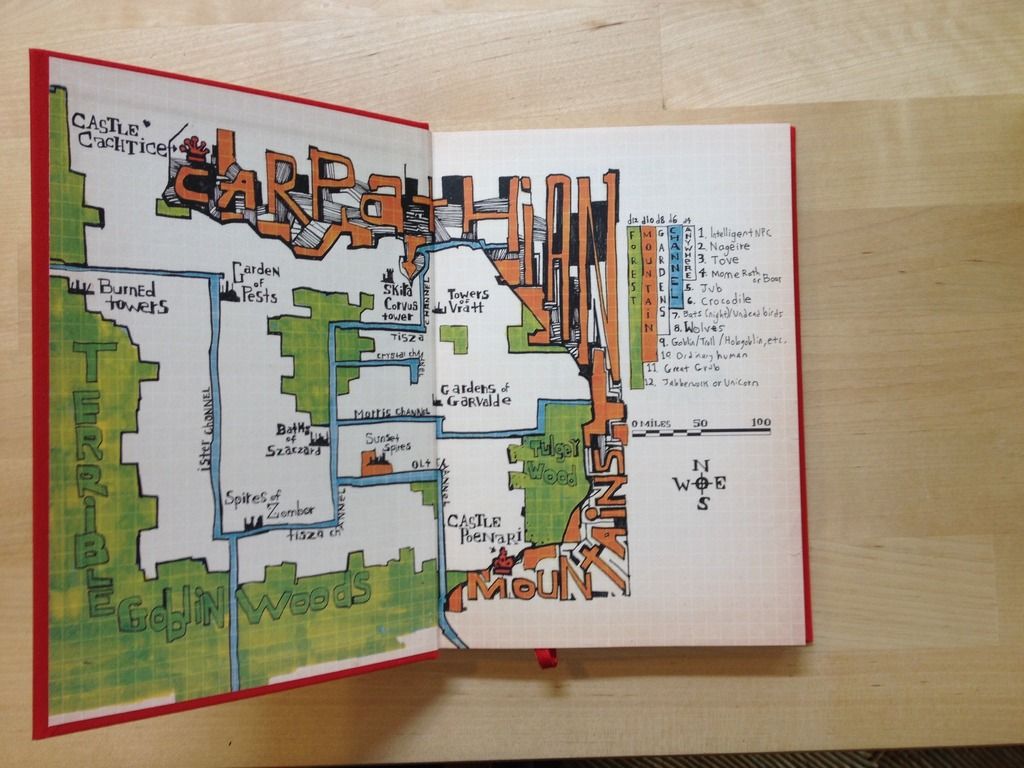
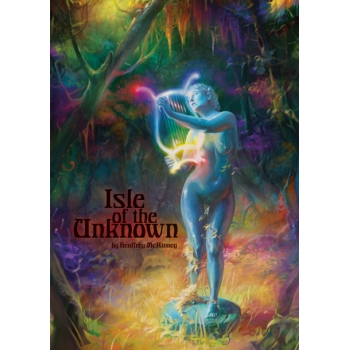
The artwork, like the other Lamentations of the Flame Princess products, is overall commendable. The cover image is colourful, vibrant and lush, with high saturation and warmth. The cover was what actually piqued my interest initially, before I bought it, due to its vivid presentation. The binding and pages are of good quality. The internal artwork and layout is aesthetically pleasing, and the inside maps are reasonable (though nowhere near the calibre of some of Wizards of the Coast's 5th edition maps). In fact, my own amateur mapping skills parallel the quality in my opinion. 

Map photograph is upside down, sorry!


A Red & Pleasant Land Review, Zak Smith, Lamentations of the Flame Princess, Isle of the Unknown, Geoffrey McKinney, Corey Ryan Walden
The contents of this book, are presented somewhat as a hex-crawl. Each of the 330 land hexes contain a point of interest - such as a town, a monster, a statue, or a magic-user. I really like the full-page colour illustrations included for the NPCs of note. 

Some of the monsters are quite inventive, and all are presented as being unique or never 'taken from any previously published role-playing game product'. I believe this, but it doesn't really impress me for reasons I'll talk about later. The notable magic-users and clerics often have some interesting background details, as do some of the towns. The statues are generally reasonable too. This book provides some genuinely interesting adventure ideas. 


A Red & Pleasant Land Review, Zak Smith, Lamentations of the Flame Princess, Isle of the Unknown, Geoffrey McKinney, Corey Ryan WaldenA Red & Pleasant Land Review, Zak Smith, Lamentations of the Flame Princess, Isle of the Unknown, Geoffrey McKinney, Corey Ryan Walden

I would be inclined to do as the author suggests with this work: 'cherry pick'. I believe that's what the author himself does, and this makes sense, especially due to the varying quality of the monsters presented herein. Which leads me to...

The Bad
Although I applaud McKinney in his attempt to 'ensure freshness and a sense of wonder and newness as your players explore a realm that is truly unknown', I feel this work is lacking in several fundamental areas. Firstly, I cannot help but compare it to his other work: Carcosa. Though I intend to review Carcosa at some stage, I will with brevity, say right here that the latter feels like a more comprehensive product; that is, Carcosa is more entirely useable. Isle of the Unknown by contrast, often feels piecemeal - slapped together to fulfil the full quota of 330 land hexes. The construction and presentation of the monsters feel a bit like a mad haberdasher sewing bits of animals or monsters to each other, creating a kind of Frankensteinian freak of nature. Like this guy:


A Red & Pleasant Land Review, Zak Smith, Lamentations of the Flame Princess, Isle of the Unknown, Geoffrey McKinney, Corey Ryan Walden


I mean, a weasel with four vipers growing out of it? No wonder he looks so sad and confused. I like weird, and I like off-beat, but the execution of this reminded me of someone trying to be different for the sake of different, without any real sense of inspiration or muse. There is no solidifying theme across this work, besides the vague historical references, and the idea that everything in the book has to be somehow 'unique'. Honestly, this work would have benefitted from some screening and revision. Had a bit more time been taken to refine this, I believe an entirely different product could have been released. One with exceedingly more practical application.

Final Thoughts
Overall it may sound like I don't like Isle of the Unknown. I wouldn't distinctly say that's true, but I also don't know whether this book will retain a long-term place on my gaming shelf. I intend to pick bits and pieces from it, or use it for quick inspiration, particularly if I'm feeling a bit dry creatively. Segments of this work have a certain charm about them, and although I feel it lacks overall cohesiveness there are some discretely creative aspects I do like. I doubt I'd use many of the monsters, but I may be surprised.

Would I recommend someone purchase this? If I only had $22 to spend on a gaming product, I wouldn't. Buy Savage WorldsSlumbering Ursine Dunes or Yoon-Suin: The Purple Land instead. But if you have a bit of extra cash and curiosity I doubt you'll be too disappointed with Isle of the Unknown, especially if you're already aware of these critiques. I wasn't disappointed, because I knew what to expect. It's a book I wanted to love, and despite its flaws and cumbersome wackiness it still retains some of its charm. I'll try it at the table, and if it plays differently than it reads, I'll be sure to let you know!


* It seems the 'community' is somewhat undecided on how to digest these products: they're kind of a 'fuck you' product, and it seems that certain people are a little sensitive about that. To be fair, some of the themes and content of certain LotFP products do tackle rather unsavoury topics, but I personally do not care how people game in their spare time, nor do I feel any particular censorship on gaming products is required.