Author: Geoffrey McKinney
Price: $37.95 (From Noble Knight Games)
Format: Print + PDF
Page count: 275
System: Lamentations of the Flame Princess (implied)Year: 2011
Note: This post contains content that some may be sensitive to. Please be advised.
Geoffrey McKinney's Carcosa caused a stir when it was first released in 2008 (self published). Clearly situating itself within the Original Dungeons & Dragons paradigm, Carcosa referred to itself as 'Supplement V'. It was the aspects of Carcosa's content more than anything, that caused the controversy. Whether or not this reception was founded, I will leave up to the reader's discretion. I am of the opinion that censorship need only exist in the format of a warning (which is exactly what this product comes with), thereafter the consumer should be able to make an informed decision of the product's merits or shortcomings. That being said, I can completely understand why some felt the way they did about this product, as quite clearly this text falls well outside the realms of 'normal' Dungeons & Dragons. The version that I am reviewing is the Expanded Edition published and released by Lamentations of the Flame Princess.
The Good
This book comes with a warning: 'For Adults Only!' Like many Lamentations of the Flame Princess products, there is no intention to pander to generic tropes of fantasy role-playing, and in my opinion this is the real strength of the publisher: they are willing to push the envelope of what D&D can be. Like any good art, this is a necessity. Role-playing games are a 'creative' endeavour, thus I do believe the hobby requires artistic integrity for continued development. This is particularly necessary to avoid stagnation (though of course there are appropriate ways to achieve this goal).
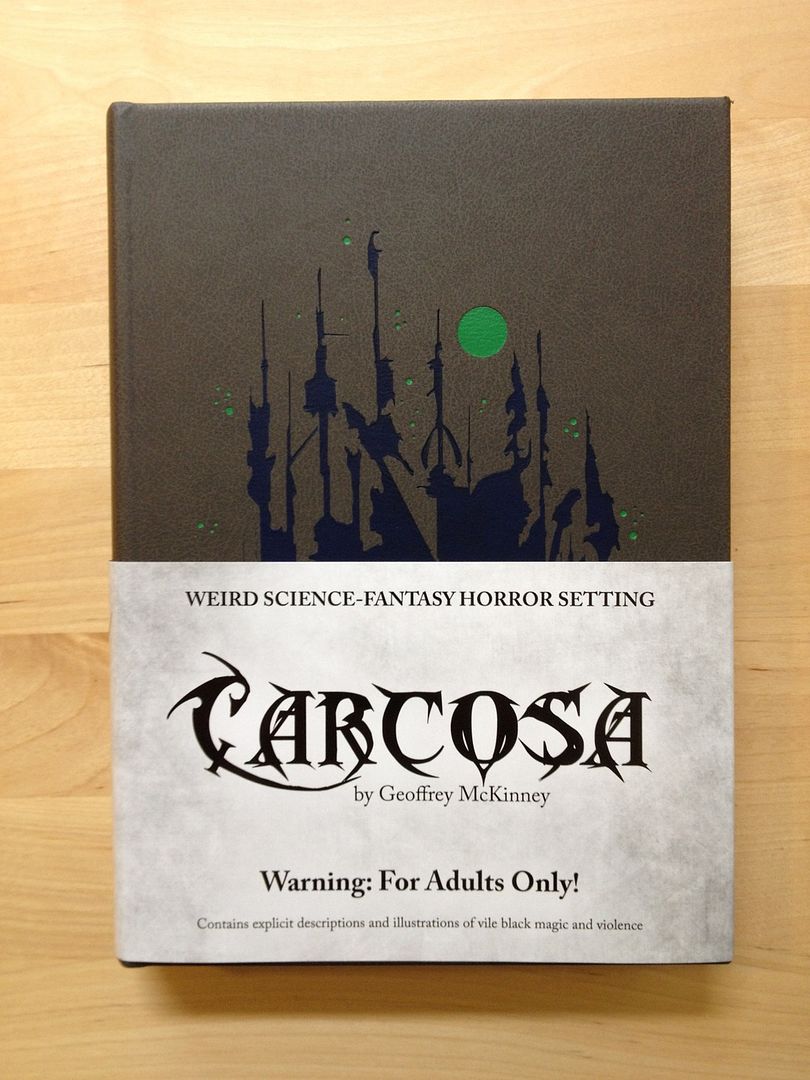
The cover and binding of Carcosa is elegant. It is a soft faux-leather/material and is very aesthetically pleasing. It contains an enigmatic illustration of a watery city, spired and illumined with a green moon-like orb, and clusters of green star-like dots. The artwork reminds me strongly of the old pulp tales, though stylistically it is dissimilar. It is the intrigue of the illustration that emanates a distinctly pulpy aura. It is successfully mysterious. The back of the book has neither illustration nor words, and the spine presents only a curious symbol, similar stylistically to the cover illustration. Both cover and spine are devoid of words or title, thus the reader is forced to open the pages to extract the book's identity. It is reminiscent of Lovecraft's Necromonicon and is extremely thematic to the text - being a grimoire of forbidden knowledge.

Lurid purple maps are within the front and back covers: one is of Carcosa's overland geography, the other details one particular hex. While bright and flamboyant they again dwell securely within the palette of the book, following the green, purple and black colour scheme. The maps are a big improvement (in my opinion) to those featured in Isle of the Unknown, both in clarity, thematics and practicality. I like them.
The other illustrations within the book vary from intriguing to somewhat repulsive. One image in particular I find hard to look at: it depicts a vat of naked humans, bearing expressions of both misery and fear on their faces. They are being ignored by a stern sorcerer intent on sacrificing them, and a prodigious entity above him to whom he makes the sacrifices (see below).
Others illustrations depict monstrous beings, fight scenes between denizens, prodigious cauldrons filled with strange substances, dinosaurs, aliens and technology, fungus and weird structures. In sum the artwork is very well executed, save for that one image that is personally too much for me. The layout, like most Lamentations of the Flame Princess products is exceptional. I value the precision of the font size, and the sparseness of words on each page. It reads more like a guide and less like a scholastic textbook, as other RPG products are wont to do.
Besides appearances, the content is consistently creative. I find it a marked improvement over Isle of the Unknown, resulting in a clearer, cohesive, and more considered work. The introduction makes it transparent to the reader that 'Carcosa is not Tolkien, high fantasy, or mainstream fantasy'. Good! The literary inspirations are crystalline, citing Lovecraft, Howard, Carter and Moorcock. The book continues with dice conventions. Carcosa departs markedly from conventional D&D (or whatever you're running) as far as dice rolling is considered. Instead, monster and PC hit die vary encounter to encounter, as does the amount of damage one deals. Handfuls of dice are rolled, rather than the few one may normally utilise within a game. There are tables for measuring this, and the mechanics are fairly clear (if slightly superfluous). I asked Geoffrey about the rationale for this mechanic recently on Dragonsfoot. His explanation was that he had purchased a large quantity of dice and needed to create a mechanic to use them. As they say, 'necessity is the mother of invention'. I'm unsure at this stage whether I would use this approach, but thinking about it, it could add some uncertainty and ambiguity to match the theme of the setting's hellish and esoteric landscapes. Characters within Carcosa may only be fighters and specialists (similar to a thief), and a new class: the sorcerer. The latter can fight in armour and utilise weaponry as a fighter, but have access to the hideous rituals within this tome.
The psionics system within Carcosa is simple and effective, though I personally would increase the % chances for characters to potentially possess these abilities. Besides this minor nitpick I prefer McKinney's implementation above other systems I've seen. Following the psionics section, other aspects of Carcosa are detailed, such as lotus plants and their effects, various technologies of enigmatic purpose, and an adventure 'Fungoid Gardens of the Bone Sorcerer'. Sorcerous rituals are detailed within this book too, and generally require an ingredient that must be gathered from a certain hex, and most require the sacrifice of human beings. These types of entries - the sacrifice, the worship of appalling entities, and the overall mistreatment of humanity was where much of the controversy stemmed. I can see why, as again, some people veer well away from these themes. My own games can be pretty macabre, but these descriptions were occasionally off-putting. At times I did feel squeamish reading through some of the ritual descriptions.
The monsters are clear and inventive. There was nothing out of place or tacky about the monsters (unlike Isle of the Unknown). I would definitely use them within my games. The hex descriptions contain two points of interest. For those running a hex crawl these points of interest are exactly that: interesting. Again I must make a comparison to Isle of the Unknown where many of the hexes were essentially useless, rendering a hex crawl therein nigh impossible without some serious intervention. Hexes detailed in Carcosa are much more compelling. It makes me want to run an adventure or two in Carcosa immediately. You can literally conduct a hex crawl with this product. The end portion of the book describes 'humanity on Carcosa' in addition to tables, mutations and a robot generator. All good stuff.
The Bad
While there weren't any significant shortcomings to this work, I do feel like the sorcerous rituals became somewhat repetitive. Yes, okay, we need to sacrifice some green men, or yes, we need to find some maidens and slaughter them between a black stone, etc. I find this overall repetition recurrent within McKinney's work - one idea is hashed and rehashed repetitively. In Isle of the Unknown the repetition was that 'everything is unique' (until nothing is unique), in Carcosa it's that 'everyone is really wicked, worships loathsome entities, and people get sacrificed a lot'. I found this repetition to be far more digestible in the current work because it fit the overall theme. It was without the kitschiness Isle of the Unknown possesses. Carcosa is very inventive and compelling. McKinney should be proud. As I mentioned above, one particular illustration bothered me, but the warning on the cover is very explicit about the contents being explicit. I knew what I was getting myself into. Please let me be clear that this work is DEFINITELY NOT for some gamers. If you're into high fantasy, with elves, dwarves, halflings and gnomes living in basic harmony, replete with very obvious baddies and goodies this work may leave you reeling; no one is 'good' in Carcosa. Some of the themes and descriptions are pretty dark. In Carcosa Drizzt will think the Underdark was a vacation, Elminster will be devoured by the Old Ones and Tasslehoff will suffer a long and grizzly death, hopefully along with the rest of his kind (can you use Kender for these rituals?).
Final Thoughts
Overall Carcosa is a commendable effort. McKinney's writing and creativity is noteworthy in this volume, while Lamentations of the Flame Princess' exceptional production values make this book a truly visceral experience. If the content of this review appeals to you thus far I would recommend its purchase. If you're bored by generic D&D fantasy, you'll probably find this work much to your liking. Conversely this tome is not for the faint-of-heart. It does contain horrific themes, and as such, may be off-putting to some.
I have a double review for you today.
After not buying anything from Lamentations of the Flame Princess, ever, but repeatedly hearing things* about the brand I decided the time was impending for me to taste of the fruit. Today was a good day because... *drum roll*
...this arrived!
But what's in the box?
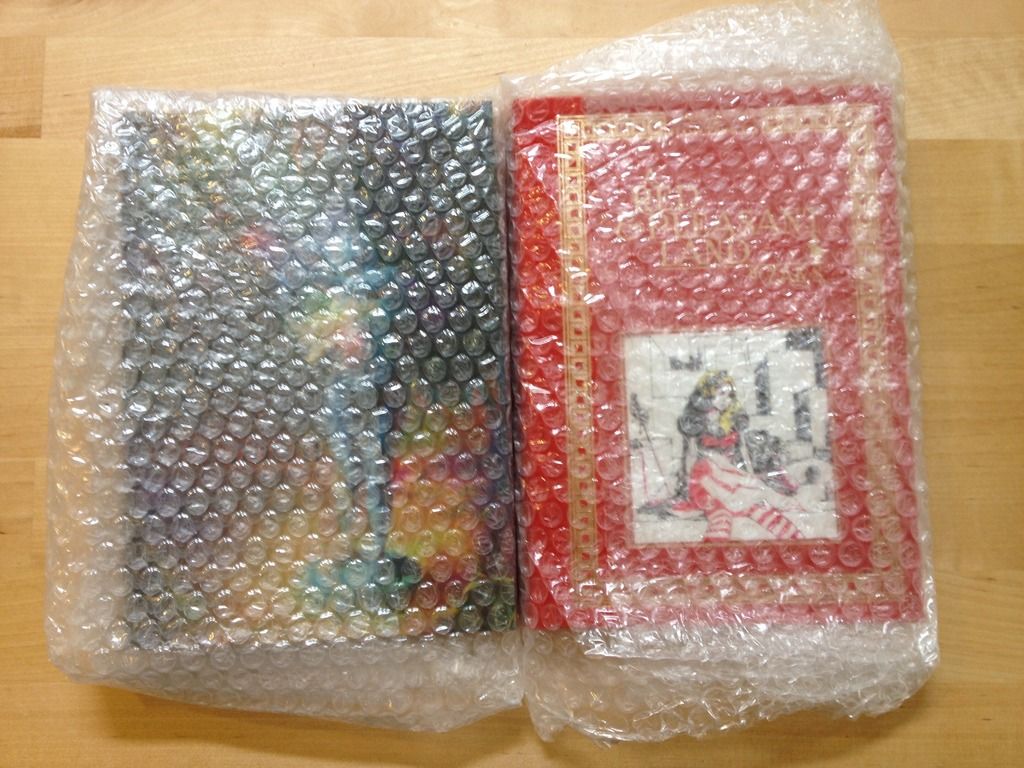
When the bubble wrap was removed, this is what I saw:

Yes, those of astute disposition will surely recognise A Red & Pleasant Land by Zak S., alongside Geoffrey McKinney's Isle of the Unknown. I have had my eye (or consciousness) on McKinney's Carcosa for awhile too, and finally put in an order from Noble Knight Games. James Raggi (owner of LotFP) got these pictured books sent off quickly, beating my Noble Knight order to arrive, even though Carcosa was ordered a week or so before these books! For the record, James will also honour customers with a free PDF download copy of any LotFP book you have purchased in the past, provided you can produce some proof of purchase. Consequently I have been reading through these three books via PDF before they even landed on the fair shores of New Zealand, and already have a good notion of their contents. Although I digress, I have found LotFP to be a good company to deal with thus far, both in speed of delivery and my personal dealings with Mr Raggi. Tick that box.
First things first. These products make some presumptions, namely that:
A) you'll be using their system Lamentations of the Flame Princess - Weird Fantasy Role-Playing, which seems fairly similar to OD&D/Basic.
B) that you're not a G or PG rated kind of player, and don't mind a bit of madness/darkness in your games.
The first is certainly not a deal breaker. Any gamer with any knowledge of role-playing games should have no difficulty translating these products to their game of choice. The second is much harder to get around, you either like an M or 18+ style of gaming or you do not. Having said that, if one opens their mind a little, and actually digs into these products, you'll certainly find inspiration in abundance. And of course, not all of it, nor even the majority of the content is that extreme. That Raggi has been rather successful as a publisher suggests there is a market for it, and alongside Astonishing Swordsmen & Sorcerers of Hyperborea provides a niche of gaming I personally really enjoy.
A Red & Pleasant Land:
Author/Artist: Zak S.
Price: 35.75€
Format: Print + PDF
Page count: 187
System: Lamentations of the Flame Princess (implied)
Year: 2014
The Good
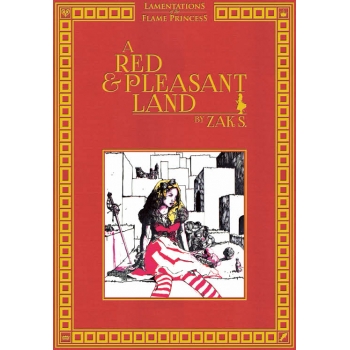
An old adage goes something like 'don't judge a book by its cover', yet that is what we inevitably do. I guess that's as good a place to start as any, thus I will. The cover reminds me of a novel from the 19th or early 20th century - reminiscent of a Charles Dickens volume, or a novella you may expect to find in an antiquated bookstore. The difference being it is very 'new' looking, and is extremely vibrant. It is red (surprise!), and embossed with gold. Sitting on one's bookshelf, it would be indistinguishable as an RPG product, and I like that; it's very thematic. The image on the front features a rendition of what I can only assume to be an 'Alice'. It contains a red, cloth bookmark sewn into the spine, while the back is simply red. In sum, a suiting cover to match the book's title.
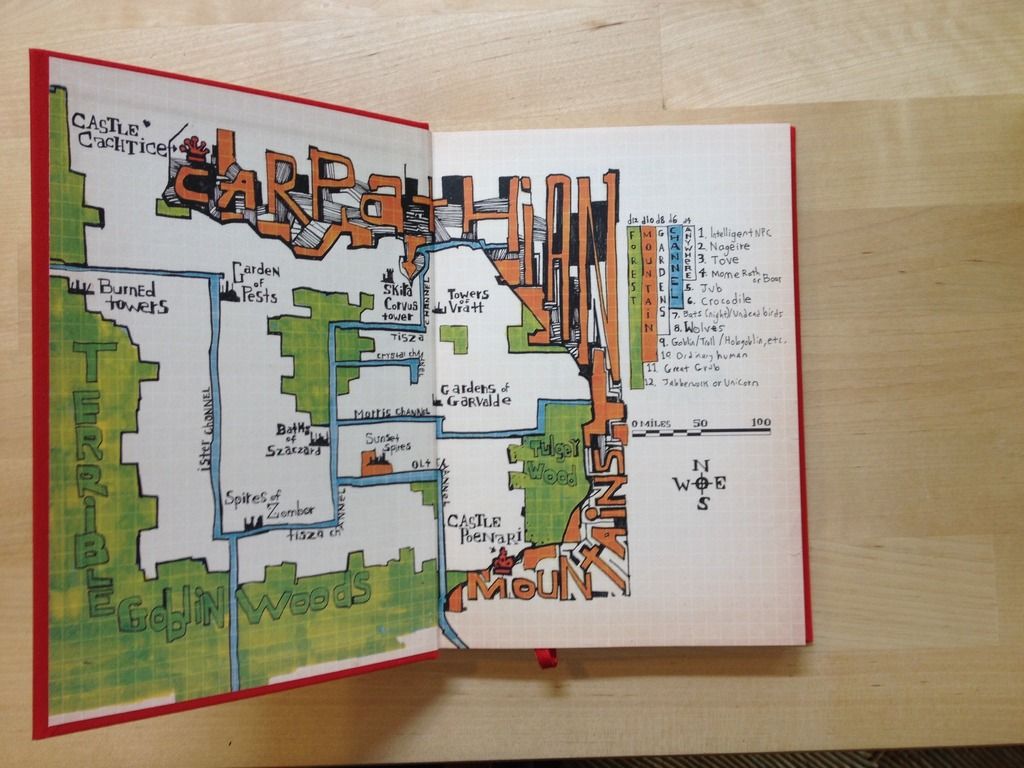
Within the volume itself, the artwork, illustrations, maps and layout is impressive, most of it being drawn by Zak himself (he is a professional artist). Thus we have interesting images that look like this
|
V
Is this a D&D map? I mean is this D&D at all? Well, it's not not D&D! And this really captures my overall sentiments on the book. It is a retelling of the classic Alice's Adventures in Wonderland by Lewis Carroll, appropriated for a D&D context. Please, let me stress this though, it goes far beyond the Alice narrative, drawing upon Transylvanian myth, accompanied with Zak's wild imagination, and amusing off-beat prose. In my opinion the artwork does as much to lure me into this setting as the writing does: both doing so equally well. It does not read like a D&D supplement, but it oozes D&D anyway. This is what Gygax meant when he said something along the lines of 'don't let us do all the imagining for you'. It follows the DIY D&D ethic, and presents the reader with something challenging; something that will invariably alter the way you approach your D&D game. That is, if you let it.
Even if you never use a single word from within this book, the artwork alone is worth it for me. But you get so much more than artwork. This is an intriguing locale (called Voivodja), which can either be used within an existing campaign (which is how I'd likely use it), or as a complete setting of its own. There are a four warring vampire houses of different colours, with varying agendas, and hapless humanity has been caught in the middle: or rather, eaten in the middle. The remnants of humanity are hiding, and due to the physics of the place, one's sense of reality is very fluid. Among various player handouts, maps, adventure locations, a new character class called 'The Alice', and quirky beasts, monsters and people, are tables for determining random things within Voivodja, and plenty of 'fluff' material for how life works on this phantasmagorical plane.
A player handout:
A monster illustration and description of the Jabberwock:
 An area map:
The Bad
Although I don't believe there's anything 'bad' about this book, I will say the utility of it may vary depending on who you are, and what style of game you prefer. For me this is not a problem: I read it as an ideas book, not a how-to. But for those of you who want to buy something you can immediately use (like a Forgotten Realms setting or something) I imagine this book may fit into the 'what the hell do I do with this?' category. I may be misrepresenting it slightly, because even if you don't use this 'whole cloth', there is plenty of useable stuff to mine from it. I plan on using this pretty liberally in my new AS&SH campaign, as I think it fits the overall weirdness and implied setting. I can see people whinging about its utility, so you have been warned. Though personally I think it's a pretty brilliant approach to a tired genre of game products...
Final Thoughts
If you like your games weird, or if you want a bit of fresh air, then I would recommend the purchase of this book. If you let it, it will speak to you in ways beyond what the words or art alone present; that is, Zak's methods will challenge your status-quo of DMing and beg the question: what else have I overlooked in my game, and what else about this hobby is tired? In a strange kind of way, this has taught me as much about DMing as Gygax's Dungeon Master's Guide did. At one stage D&D was innovative and new, this book is a return to reclaiming that.
Isle of the Unknown:
Author: Geoffrey McKinney
Price: 22.00€
Format: Print + PDF
Page count: 125
System: Lamentations of the Flame Princess (implied)
Year: 2011
Let me preface this review by saying Isle of the Unknown was a product I had wanted for awhile, but due to other (mostly negative) reviews I read online I was partially deterred. When I was ordering A Red & Pleasant Land I thought: 'screw it, Isle of the Unknown is not that expensive, and it will probably save a bit on shipping getting two books instead of one'. With that disclaimer out of the way, and with my own prejudices made transparent, let us commence.
The Good
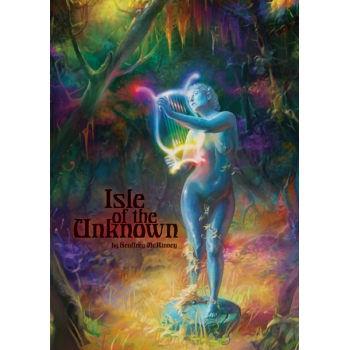
The artwork, like the other Lamentations of the Flame Princess products, is overall commendable. The cover image is colourful, vibrant and lush, with high saturation and warmth. The cover was what actually piqued my interest initially, before I bought it, due to its vivid presentation. The binding and pages are of good quality. The internal artwork and layout is aesthetically pleasing, and the inside maps are reasonable (though nowhere near the calibre of some of Wizards of the Coast's 5th edition maps). In fact, my own amateur mapping skills parallel the quality in my opinion.
Map photograph is upside down, sorry!
The contents of this book, are presented somewhat as a hex-crawl. Each of the 330 land hexes contain a point of interest - such as a town, a monster, a statue, or a magic-user. I really like the full-page colour illustrations included for the NPCs of note.
Some of the monsters are quite inventive, and all are presented as being unique or never 'taken from any previously published role-playing game product'. I believe this, but it doesn't really impress me for reasons I'll talk about later. The notable magic-users and clerics often have some interesting background details, as do some of the towns. The statues are generally reasonable too. This book provides some genuinely interesting adventure ideas.
I would be inclined to do as the author suggests with this work: 'cherry pick'. I believe that's what the author himself does, and this makes sense, especially due to the varying quality of the monsters presented herein. Which leads me to...
The Bad
Although I applaud McKinney in his attempt to 'ensure freshness and a sense of wonder and newness as your players explore a realm that is truly unknown', I feel this work is lacking in several fundamental areas. Firstly, I cannot help but compare it to his other work: Carcosa. Though I intend to review Carcosa at some stage, I will with brevity, say right here that the latter feels like a more comprehensive product; that is, Carcosa is more entirely useable. Isle of the Unknown by contrast, often feels piecemeal - slapped together to fulfil the full quota of 330 land hexes. The construction and presentation of the monsters feel a bit like a mad haberdasher sewing bits of animals or monsters to each other, creating a kind of Frankensteinian freak of nature. Like this guy:
I mean, a weasel with four vipers growing out of it? No wonder he looks so sad and confused. I like weird, and I like off-beat, but the execution of this reminded me of someone trying to be different for the sake of different, without any real sense of inspiration or muse. There is no solidifying theme across this work, besides the vague historical references, and the idea that everything in the book has to be somehow 'unique'. Honestly, this work would have benefitted from some screening and revision. Had a bit more time been taken to refine this, I believe an entirely different product could have been released. One with exceedingly more practical application.
Final Thoughts
Overall it may sound like I don't like Isle of the Unknown. I wouldn't distinctly say that's true, but I also don't know whether this book will retain a long-term place on my gaming shelf. I intend to pick bits and pieces from it, or use it for quick inspiration, particularly if I'm feeling a bit dry creatively. Segments of this work have a certain charm about them, and although I feel it lacks overall cohesiveness there are some discretely creative aspects I do like. I doubt I'd use many of the monsters, but I may be surprised.
Would I recommend someone purchase this? If I only had $22 to spend on a gaming product, I wouldn't. Buy Savage Worlds, Slumbering Ursine Dunes or Yoon-Suin: The Purple Land instead. But if you have a bit of extra cash and curiosity I doubt you'll be too disappointed with Isle of the Unknown, especially if you're already aware of these critiques. I wasn't disappointed, because I knew what to expect. It's a book I wanted to love, and despite its flaws and cumbersome wackiness it still retains some of its charm. I'll try it at the table, and if it plays differently than it reads, I'll be sure to let you know!
* It seems the 'community' is somewhat undecided on how to digest these products: they're kind of a 'fuck you' product, and it seems that certain people are a little sensitive about that. To be fair, some of the themes and content of certain LotFP products do tackle rather unsavoury topics, but I personally do not care how people game in their spare time, nor do I feel any particular censorship on gaming products is required.