Showing posts with label Gary Gygax. Show all posts

Monday, 27 April 2015

On Artwork And Inspiration: The Works of Nicholas Roerich

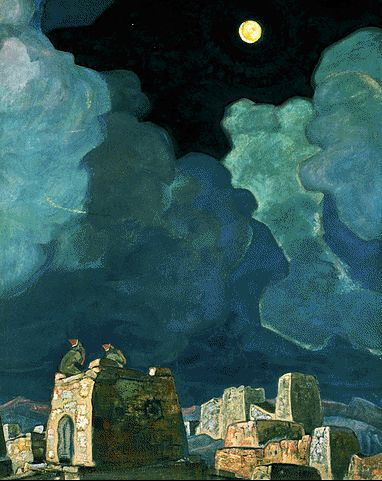
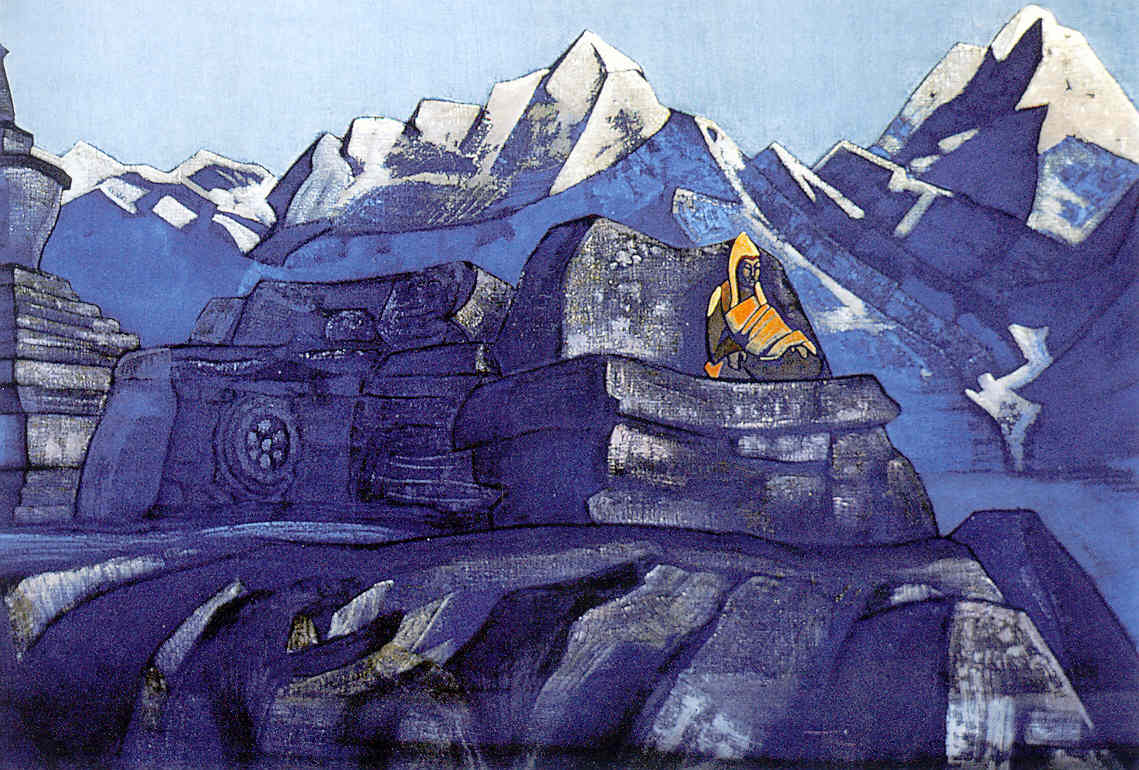
Delving into the work of H.P Lovecraft revealed to me the work of Nicholas Roerich. It would appear Lovecraft had fondness for his work, or at least considered it somewhat evocative in the creation of his own works. He cites it at least twice in his sprawling tale At the Mountains of Madness, referencing the likeness between Roerich's paintings and his own 'Cyclopean' cities. That Lovecraft was an important literary inspiration to Gygax and Arneson should also not be overlooked*.

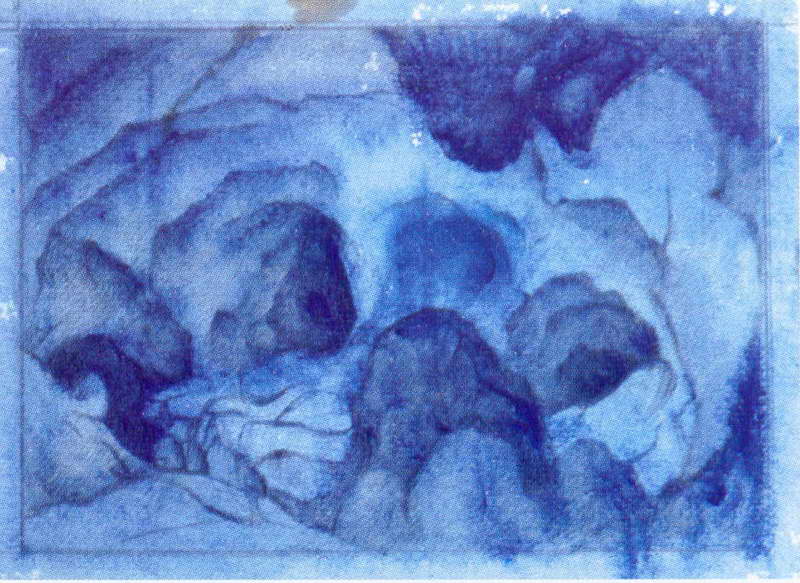
An Internet search demonstrated what Lovecraft was discussing with promptness, and in no small way helped me to visualise the megalithic black cities he referred to. While I personally find a good piece of artwork quintessential in the formulation or muse of my own writing, I feel the linkage is ephemeral rather than concreted in any discrete permanency. That is, I often find myself becoming inspired by a piece, but what begins as a visual appetite may continue in an imagined context, becoming more than the original image alone. The new piece of writing (hopefully) transcends the original piece of artwork that inspired it, becoming its own thing. The pieces I have included in this article may all contain hints as to what Lovecraft spoke of, yet no singular image mirrors exactly what I see in my mind's eye. And I think this exact distinction is important: namely that imagery and writing should assist one another, yet neither should be relied upon.

The work of Roerich in particular amasses a brilliant use of colour that I may call vivid or bold. Were these same paintings reproduced as sketches I doubt they would hold the gravitational pull I currently feel towards them. It is the uncanny representation of reality through colour and shape that I admire, in many respects mirroring a similar relationship between 'reality' and the gamed fantasies we indulge in. Our gaming worlds are somehow more vibrant or outrageous than those we may otherwise occupy, yet evocative of something strangely substantial, though often difficult to quantify.


Whether a painting of a natural cave networks conspires to amount in the creation of the 'Old Ones', or simply becomes the lair of a purple worm I see a epiphytic relationship between the two creative forms of art and writing. Most of my favourite fantasy role-playing games have artwork that somehow transports me from here to there ('there' being that other place where one thinks to themselves 'Yes! I want to travel there. But how?').The same goes for a particularly potent piece of literature. The imagery can be so sharp, and the atmosphere so poignant that I indeed travel to 'there'. Likewise fantasy role-playing games are nothing without the atmosphere they conjure, and quite frankly without sincere atmosphere I'd rather not play. 
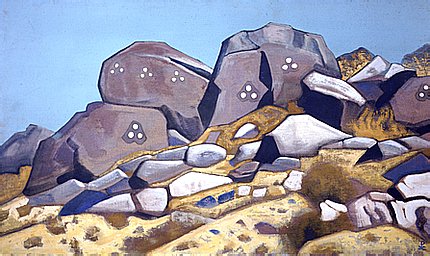

Life is too short to play in games where the atmosphere is anything but electric. A game, I feel, should inspire you to some kind of vicarious experience. It's not really up to me to determine what that is, or what that may look like, but if I'm playing a game I want to experience something! One reason I particularly like Roerich's work is that each piece hints at a cosmic greatness or peculiarity just outside of reach. Lovecraft's work hints at this too, and is probably why he elected to specifically name Roerich's artwork in his tale. Again, I think a good game will reflect this metaphysical tale: it may be a struggle with self or others, a struggle with the seeming futility or ambivalence of the world, or even the relationship between mortal 'man' and a greater being. Or you may just want to hack some monster to death (maybe on some level that monster stands in the place of something else, or maybe it doesn't). 

That lucid and liminal space between a boring old tale and something that truly inspires is a worthy pursuit, and luckily there are many excellent gaming companies that attempt to tell a 'new' tale. I for one do not want to play the same game everyone else is playing - I want to play the sort of game that me and my friends want to play. The idea of someone else writing my adventures has always been a discomforting thought, and I think it's because the creation of a tale is such a sacrosanct act. I don't mean that in a weird way, I just mean it's pretty damn cool I can sit down with my friends each week, pull out some whacky-looking dice and create literally endless tales with a few rulebooks and some imagination. The best part? We're creating these narratives communally, but in our individual minds they look distinctly different to each person playing. At least I think they do...

So then, let artwork inspire you, but let it be a springboard towards something different or more rarely, something greater.



* Check out Jon Peterson's Playing At The World (2012).

Monday, 13 April 2015

On Gygaxian Dungeons

AD&D Dungeon Masters Guide Gary Gygax Dungeon Gygaxian
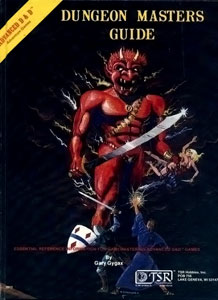
Gary Gygax's Advanced Dungeons & Dragons: Dungeon Masters Guide, published in 1979, is iconic. It's iconic for myriad reasons: it is quixotic and somehow practical both, it contains admixtures of advise, mathematics, statistics, tables and herblore, information on monsters and gems, the passage of time, combat in strange places, details of magic items, consulting sages, hiring hirelings, avoiding assassins, and examples of play. In other words, a list galore with more than I can possibly manage in these posts. One aspect, and one that I feel is frequently overlooked is the random generation of dungeons. Those of us with adequate imagination and intellect can construct reasonable or even commendable underworlds, caverns, and dungeons, aimed at keeping our players on their toes. But where imagination is sometimes exhausted, the quirks of chance can be of assistance.

Lately, or rather within the past month or so, I have been relishing the generation of dungeons in this random vein. I begin with a piece of paper. Opening my Dungeon Masters Guide to Appendix A: Random Dungeon Generation (pg. 169) I scrawl down one of the five possible examples for starting areas within a dungeon. Gygax advises to begin this process in the middle of a page, though for some unknown reason I prefer the bottom of the page. With a single d20 and a few other assorted dice, one can create some very interesting dungeons. I find this method provides an excellent springboard: it gets you going, then imagination often takes over. You can follow it by the book, or pick and choose features you think are fun. I find this method best when I have a vague notion of what may lie within these underscapes, but without exacting preconceptions. This process inevitably creates some intriguing results. The sizes and shapes of rooms seem to vary notably, along with the angles of passageways, and features both natural and manmade. Treasure, traps and monsters can be randomly generated too, and again, the results are often unpredicted. One can determine the number of exits, and on what walls the doorways are located. Caves, caverns, pools and even stairs are covered too. Finish your dungeons using Appendix I: Dungeon Dressing to add both mundane artefacts and 'unexplained sounds and weird noises' to your dungeons.

I don't care what edition you play, this process makes for some great dungeon ecology. Two recent examples have borne satisfying results. Some of you may remember the Original Dungeons & Dragons one-shot I ran some weeks ago. This dungeon was completely Gygaxian generated (though I confess, I did add a few things, or tweak a result to make more sense within the context of the adventure). I only had one prerequisite: I wanted a large underground lake. The second example is an Astonishing Swordsmen & Sorcerers of Hyperborea adventure I've been labouring away at for the past couple of months. The final level of the adventure was roughly 50% constructed using the random dungeon generation method, though in this instance I was fairly liberal with my interpretation and amendments: I need it to make sense. For this latter example I had an internal checklist of things I needed to include on this level, and the combination of random and purposeful worked well.

If you've never tried this method all you need is Gygax's Dungeons Masters Guide, a set of polyhedral dice, and a pen and paper. Conceivably you could conduct limitless campaigns with just this tool and the application of some imagination. If you are new to old school D&D, or you have simply never seen or used this resource I highly recommend it. Wizards of the Coast reprinted this book in 2013 (I think it was then), thus a new copy can be acquired reasonably cheaply. Alternatively pick up an old copy for $5-10 on Ebay. In my opinion it is a systemless tool - thus whether you are playing AD&D, Labyrinth Lord, Lamentations of the Flame Princess or 5th Edition D&D, you'll find something to assist with the construction of your underworlds. As always: happy gaming!