Showing posts with label 5th Edition. Show all posts

Tuesday, 27 October 2015

Review: Rogues in Remballo (Swords & Wizardry)


Rogues in Remballo: An Adventure for Swords & Wizardry

Author: Matt Finch
Character Levels: 1st
System: Swords & Wizardry (or similar)
PDF: Free!
Print: Kickstarter

When +Matt Finch asked for reviews of this adventure I put my hand up. I had recently acquired the hardcover of Swords & Wizardry Complete (which I really like) so I was eager to see what a city adventure may look like within this system.

I had every intention of writing/posting this earlier, but I have been kind of slack. Now that I've finally read through the adventure and given it some thought, here we are. Before I begin I want to mention two things. Firstly, this adventure is available as a free PDF from the Frog God Games website (link above). Secondly, there is an in-progress Kickstarter where one may acquire this adventure in print form as part of the larger "Borderlands" project. If this review stokes your interest I would recommend downloading the free copy first. It has been produced in black & white, making it printer-friendly. If you absolutely love it, and like the look of the Kickstarter (link above) you may wish to back the Kickstarter and get a print version.

Anyway, let's begin. Rogues in Remballo (hereafter referred to as "Rogues") is a city-based adventure of political intrigue. Finch suggests this adventure is suited for experienced groups, and I can see the logic behind this suggestion. While less experienced groups could probably handle the intricacy and relative open-endedness of the adventure, the skill required on the part of the players (and certainly the Ref) is better suited for gamers with a number of adventures/campaigns under their belt. Having said that, one of the first adventures I ran was The Speaker In Dreams which contains a similar level of nuance. Regardless, there is soundness in Finch's suggestion. In the unlikely event that you are reading this and have never run a game of Dungeons & Dragons or Swords & Wizardry, I would be inclined to echo Finch's advice. Pick something simpler. For true beginners, the 5th Edition Starter Set is not a bad way to go. But I digress.

Rogues is set within the Borderland Provinces of the "Lost Lands" setting. At times there were references to setting specific elements not explained within the adventure, but largely the adventure site would be easy enough to transplant to any setting. From the outset the reader is provided with some clear and functional maps of Remballo, keyed with particular sites of interest. This city could be placed in most generic fantasy settings, or with a bit of tweaking, would fit nicely in more eclectic realms. The setting does assume a relative level of technological sophistication (such as banking systems/letters of credit), so these aspects may need modification if your setting is more primitive.

The main contention of the adventure revolves around two powerful forces within the city: The House of Borgandy (who have had one of their own disappear) and the local Thieves Guild. Additionally there are some other major forces at work, particularly the Thieves Guild of Manas and the City Watch. This adventure is largely non-linear, though there is a logical progression between beginning and end which is likely to coalesce in a number of possible outcomes: beginning within the walls of the city, progressing to an area called "The Four Corners", and reaching climax beneath the city itself. What happens in between is largely up to the detective work of the players/characters, and without skilful implementation by the Ref, this adventure could quickly become directionless or somewhat vague. At times this adventure appeared to be an exercise in door-knocking: "Hello sir, could I bother you for a second? Oh, you don't know anything about this event? Okay, well good day." As some of the NPCs were described as grumpy, this may deter players, appearing to be a dead-end approach to discovering the required information. I suspect that the adventure could have been signposted a little better. There are, however, a number of compelling motivations to get the participants interested in the adventure — including the classic incentive of gold payable from the coffers of The House of Borgandy and the local Thieves Guild. Smart or lucky players will be able to double dip and capitalise on the rewards of both. There is room for deviancy too, particularly towards the end where certain...goods...can be "acquired" from certain (probably dead) individuals. Finch provides a satisfying level of detail regarding the political factions within and without the city. This inclusion creates a satisfying and believable backdrop from which to hinge the whole affair. At this point I won't give too much away, lest I spoil the adventure if you wish to play/run it.

The setup and presentation of Rogues is clear with a satisfying balance between sparseness and depth. The Ref is at substantial liberty to flesh out various places, people, or events. The adventure often paints broad brushstrokes, and while this is largely appreciated there were times where multiple entries became prosaic. For instance, let's look at area #19:


This entry is fairly mundane, and I would ask whether it's even needed? There were a handful of similar entries, which became dull to read. At this point I don't really feel the need to know Jarn's name; who is he? Instead, I thought these types of entries could have been tidily subsumed into a random table rather than afforded separate entries of their own. The Ref could roll on the table if he/she needed to know the occupant of the building. If Isarn Jarn were a more interesting character I probably wouldn't have minded. For example, maybe his leg is injured, and when asked about the goings on in the city he becomes cagey (inferring he's hiding something), maybe he has a block of cheese on his belt, offering slices to visitors, or maybe his eyes constantly shift to a part of the room the characters can't see. More detail would have been good, or a more compelling reason why Jarn warrants his own entry. The latter part of the text was more eventful and pertinent to the adventure. I enjoyed the inclusion of the opium den, and the notion that violence and thuggery was associated with this undercurrent of the city. Again though, I felt this could have been developed a bit further. I mean, an opium den should be rife with atmosphere. Maybe a well-known local figure is either funding or frequenting the joint, and happens to be there when the characters turn up. How does the den look, smell, or feel? Similarly, the thieves guild felt a little too familiar or friendly. There was one mention of guild members getting executed if they committed a certain offence, but otherwise I would have liked a more ominous or menacing guild for players to interact with.

Despite the flatter 2D aspects of this adventure, I still felt like it was a good effort. There is plenty of intrigue, and for parties who enjoy investigative scenarios this makes for a very viable adventure. While generic fantasy, I did not see this as a negative thing. I felt oddly excited reading parts of Rogues. Again, I return to The Speaker In Dreams, because I have fond memories of that adventure. Both adventures have a similar feel (I'm not sure why), providing the Ref with the framework for a broader campaign. There were many events, situations, or conflicts that I felt could be readily developed. Various things were implied or mentioned in passing which allows the Ref to build on Remballo as an interesting adventure location. I imagine this would be a very fun adventure with the right group. My players would certainly enjoy it.

My recommendation is to download a free copy. I enjoy Matt Finch's writing. It's clear, punchy, and to the point. At 26 pages it does not take long to read, and you will very quickly decide whether it is right for you. Of the free adventures floating around the Internet, this one is solid, so take a look. Overall it is very good, but the mentioned caveats reduced my estimations somewhat. 

Saturday, 1 August 2015

Sandboxing (A Work In Progress)

Sandboxing - Corey Ryan Walden

I've decided to compile a growing collection of tables into one booklet. The purpose: to assist with an upcoming hexcrawl/megadungeon/sandbox campaign I'm working on. Maybe other people will enjoy them too. I've already published three of these to my blog, but I've attempted to tidy them up somewhat in a slightly more professional manner. 

The booklet is aptly entitled "Sandboxing". I will continue to add new tables to the booklet, as I create them. It will be available exclusively (for the moment) from my downloads page. If it grows to a publishable size, I may look at making a print-on-demand version available. If you like it, keep checking back. This is a long-term project, and I have two other projects of much higher priority, but I do hope to keep plugging away at it over the next year or two. 

Get it directly from HERE or check out my downloads page. 

Tuesday, 23 June 2015

NPC Dispositions Table - D100


_____________________________________________________

NPC Dispositions Table


      I.   This table can be used to determine an NPC’s personality or traits.
                             II.   This table can be used during a chance encounter, or for a known NPC’s ephemeral reaction or current mood.
  III.         Roll 1d100 and match the result to the table below; this is the NPC’s disposition.
  IV.         Repeat to your heart’s content.


Friday, 1 May 2015

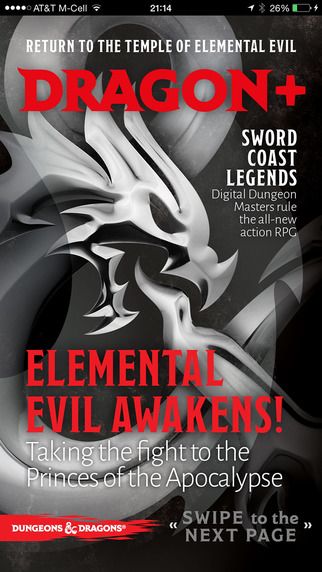
Dragon+

Free to iOS, is Dragon+. It seems to be the newest rendition of the now defunct Dragon Magazine. It's free (for now) and can be acquired on iTunes App store. It is focussed on 5th edition Dungeons & Dragons. 

Love it or hate it, there is a lot happening at the moment regarding this edition, and for the hobby overall. There are plenty of reports of new players congregating to the hobby, and I think that's important. I for one really enjoyed my brief stint with running 5e, having at one stage close to 10 players at the table. One indication of a robust system is the ability for combat to keep moving, and even with that many players it did so well. 5e gets my vote even if I'm not playing it at the moment (I do own all the books). Being endeared with an OSR style of game I have been unable to escape the old school lure. 

But anyway if you're on iPhone or iPad you can download Dragon+ for free and access additional content pertinent to the 5e game, especially for their current Elemental Evil adventure line. 

More info HERE

Thursday, 16 April 2015

Give a man a monster, and he'll game for one day; teach a man to create a monster, and he shall game forever.

My facetious take on an old proverb may be irreverent but it's true. I have in my collection tomes upon tomes, filled with monsters. My collection begins with the monsters presented in the 3 little brown booklets of Original Dungeons & Dragons. Add in the supplements like Greyhawk and Blackmooor and it's beginning to feel like Advanced Dungeons & Dragons. But why stop there? There is the Basic and Expert box set by Tom Moldvay and David Cook. There are real some goodies within, and of course we must not forget the aforementioned AD&D monster manuals. For good measure I also have the OSRIC rulebook and the Astonishing Swordsmen & Sorcerers of Hyperborea box set (both being representative of the content emerging from the OSR). Both of these present unique monsters, drawn from fandom or from the pages of Lovecraftian et al, tales. The 2nd edition Monstrous Manual sits next to them on my shelf, and again, is filled with a menagerie of options. I gave away my 3rd edition books some time ago, but again, we have similar monsters represented therein, and some different. I skipped 4th edition entirely, so cannot comment on that. Finally my 5th edition Monster Manual contains some of the classics we've all grown to love. I could throw in the adventures and other supplements I own: boxsets, modules, and my recently acquired Lamentations of the Flame Princess products (Carcosa, Isle of the Unknown, A Red & Pleasant Land). At this point you may be begging me to stop; and I shall.

These are all resources at my disposal, yet I'm inevitably drawn to my own imaginings when it comes to the various underworld (or wilderness) horrors appearing in my games. Don't get me wrong, I liberally borrow from the manuals I own, but when constructing my campaigns my position is always 'flavour first'. In many respects the system one plays is irrelevant, so long as it works for those at the table. The Internet is proof there is no definitive answer as to which system is inherently 'better'. Forums, blogs, websites, videos, and so on, are filled with nerd-raged fans proselytising the virtues of their edition of choice. At least it cannot be said of this subculture that we are passionless people. So play whatever you want, and be sure to have fun. The issue remains however, if whatever is being run is not working for you in your role as the DM. Nearly two years ago I started writing a Pathfinder campaign (which has concluded recently). My biggest frustration with that particular system was that it took so damn long to stat everything out. It interrupted my workflow and creativity. 'I would continue writing, but I need to work out NPC X's skill distribution'. Yeah. Not fun. Inevitably too, the flavour of the game was imposed by the ruleset I was using: I wanted a low magic, and somewhat underpowered campaign, yet mechanically and aesthetically this was a real stumbling block. In my opinion I ultimately failed in my mission, but you'd have to ask my players their opinion on the matter. Sure we had a good time, but it wasn't quite what I was attempting to achieve. The system got in the way.

The draw of simpler systems, whereby one can compose a stat block within 5 minutes has some real appeal in comparison. I can conceive of a monster, think 'damn that's awesome', and have it on paper within a very short duration. I can then continue my debased preparations, cackling occasionally as I scheme of the various horrors soon to be assailing my adventurers. Dungeons & Dragons from the outset, it seems to me, has always been about creativity and freedom. Creativity to conceive fantasy worlds of one's own devising, and to inhabit it with people and creatures. Imagine fiefdoms and baronies, or a race of alien overlords who enslave humanity for their own unknowable agendas. The geography is up for negotiation. Want a mountain here? Sure. This is a cave inhabited by men who farm giant worms? Sure. Even the physics and laws we must obey on Earth can be bypassed, manipulated or even ignored. Planets exist only as they're needed, or a campaign can exist purely within a flat-earth concept. Magic enables planar travel, invisibility and ultra-healing where in our world we say 'impossible!' The freedom within D&D, comes from exploring these worlds. A bank teller, an IT expert, a CEO and a taxi driver can set aside their 'mundane' identities for a few hours and be something they never were/are in reality, yet somehow represents them in an uncanny way.

Which brings me back to where we started: our rulebooks, our supplements, the products we purchase and the dice we use should be subservient to us. They are there to inspire, to motivate and enable our games as we envision them. They are not there to become a burden or a blockage to what we are trying to achieve. TSR's slogan used to be 'Products of your Imagination'. In other words, the system should disappear into the background, as your imagination gives birth to, and takes precedence over, your collective gaming experiences.

So go... Find a system that is effective in design and implementation, and enabling of the flexibility you need. Imagine those monsters, create those worlds, and you too shall game forever young grasshopper.

Monday, 13 April 2015

On Gygaxian Dungeons

AD&D Dungeon Masters Guide Gary Gygax Dungeon Gygaxian
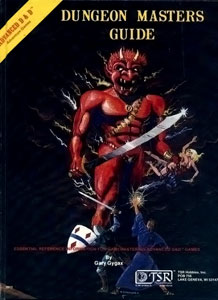
Gary Gygax's Advanced Dungeons & Dragons: Dungeon Masters Guide, published in 1979, is iconic. It's iconic for myriad reasons: it is quixotic and somehow practical both, it contains admixtures of advise, mathematics, statistics, tables and herblore, information on monsters and gems, the passage of time, combat in strange places, details of magic items, consulting sages, hiring hirelings, avoiding assassins, and examples of play. In other words, a list galore with more than I can possibly manage in these posts. One aspect, and one that I feel is frequently overlooked is the random generation of dungeons. Those of us with adequate imagination and intellect can construct reasonable or even commendable underworlds, caverns, and dungeons, aimed at keeping our players on their toes. But where imagination is sometimes exhausted, the quirks of chance can be of assistance.

Lately, or rather within the past month or so, I have been relishing the generation of dungeons in this random vein. I begin with a piece of paper. Opening my Dungeon Masters Guide to Appendix A: Random Dungeon Generation (pg. 169) I scrawl down one of the five possible examples for starting areas within a dungeon. Gygax advises to begin this process in the middle of a page, though for some unknown reason I prefer the bottom of the page. With a single d20 and a few other assorted dice, one can create some very interesting dungeons. I find this method provides an excellent springboard: it gets you going, then imagination often takes over. You can follow it by the book, or pick and choose features you think are fun. I find this method best when I have a vague notion of what may lie within these underscapes, but without exacting preconceptions. This process inevitably creates some intriguing results. The sizes and shapes of rooms seem to vary notably, along with the angles of passageways, and features both natural and manmade. Treasure, traps and monsters can be randomly generated too, and again, the results are often unpredicted. One can determine the number of exits, and on what walls the doorways are located. Caves, caverns, pools and even stairs are covered too. Finish your dungeons using Appendix I: Dungeon Dressing to add both mundane artefacts and 'unexplained sounds and weird noises' to your dungeons.

I don't care what edition you play, this process makes for some great dungeon ecology. Two recent examples have borne satisfying results. Some of you may remember the Original Dungeons & Dragons one-shot I ran some weeks ago. This dungeon was completely Gygaxian generated (though I confess, I did add a few things, or tweak a result to make more sense within the context of the adventure). I only had one prerequisite: I wanted a large underground lake. The second example is an Astonishing Swordsmen & Sorcerers of Hyperborea adventure I've been labouring away at for the past couple of months. The final level of the adventure was roughly 50% constructed using the random dungeon generation method, though in this instance I was fairly liberal with my interpretation and amendments: I need it to make sense. For this latter example I had an internal checklist of things I needed to include on this level, and the combination of random and purposeful worked well.

If you've never tried this method all you need is Gygax's Dungeons Masters Guide, a set of polyhedral dice, and a pen and paper. Conceivably you could conduct limitless campaigns with just this tool and the application of some imagination. If you are new to old school D&D, or you have simply never seen or used this resource I highly recommend it. Wizards of the Coast reprinted this book in 2013 (I think it was then), thus a new copy can be acquired reasonably cheaply. Alternatively pick up an old copy for $5-10 on Ebay. In my opinion it is a systemless tool - thus whether you are playing AD&D, Labyrinth Lord, Lamentations of the Flame Princess or 5th Edition D&D, you'll find something to assist with the construction of your underworlds. As always: happy gaming!