As I have previously stated, I am running an upcoming OD&D campaign using mainly White Box rules, and custom classes (if the players want something divergent).
Besides my recent Warlock class, another of my players requested a custom class: a wizard who could transform into a house cat. Developing this idea, further I present you with: The Werecat.
Available from my "Downloads" section, or by following this link HERE
Showing posts with label DIY. Show all posts
Wednesday, 2 September 2015
Thursday, 27 August 2015
Dungeon Lord Zine "The First Issue"
Free stuff is awesome. +Taylor Frank is quite the magnanimous character, sending me a copy of his Dungeon Lord Zine.
This thing is pretty awesome. I enjoy an abundance of colour; something you may have witnessed in my own offerings. The interior of this zine is printed on bright green paper, bearing an equally colourful (and pleasingly violent) cover. Although presented as being "compatible with DCC RPG", it is an ideal candidate for general idea-thievery. Okay yes, it's also suitable for DCC players too. The First Issue begins strongly — the interior cover has a one-page adventure.
The adventure is penned by Ron Yonks and is entitled Calcified Caves of the Slime Yeti. Mechanically it is very minimal — the sort of minimalism that endears me to the immediate possibilities. I'm totally going to throw this into my upcoming OD&D campaign as a side-jaunt. I'll change some things of course, but I could almost run it as written.
The next page is the credits page. Mine came with a temporary tattoo (yes, you read correctly. I have some real ones, but the idea is still fun), and a hand-written note from Taylor. My copy is "damaged" and was thus free. It has some ink stains and a few rough edges. Taylor explains this, but elaborates that it is still a "good example of the issue". Yes it is Taylor, it's a very good example. I received a bunch of stuff from Stormlord Publishing this week, and comparatively they are very fastidious with their workmanship. However, I really appreciated the from-me-to-you aesthetic of Taylor's zine. It's homely, and I think that makes it inviting. If I spill coffee on it I won't really care, but that's how game materials should be used. I have a lot of stuff on my bookshelf that I'm overly careful with because it's effectively too "nice" to use. Dungeon Lord begs you to use it. I will.
The bulk of the zine is comprised of an adventure: "The Caves of the Sacred Seven". I can't be bothered explaining the plot, but it was a nice balance between "ecological" (or sensical) and gonzo. Again, I'll probably use some/all/bits of this in my OD&D campaign. It makes an interesting locale for adventure, with the possibility of finding some nice magic items. It has cavemen, reptilians, dinosaurs, transmuting corridors, "wild men", psychedelic spores, and a "hovel". My kind of adventure. Some bits are slightly silly or not quite my bent, but the basic structure is definitely pleasing. The Caves of the Sacred Seven is fairly basic in execution, providing enough detail to run, but not too much. The reader does not become bogged down when attempting to run it "correctly". It isn't long, and it isn't short. The remainder of the zine varies in usefulness: I didn't like The Tomb of Zarfulgar the Lost (another adventure), but I appreciated the simple (if slightly bland) blank dungeon on the back cover, the historical account of this zine's inception, and the "Random Dungeons Elevation" generator. One page of the zine was a poem, which I was decidedly ambivalent about. It wasn't horrible, more of a page filler.
Conceptually, I want to discuss two things that particularly impressed me about this issue/zine. The first is the artwork. No one could accuse this zine of an enormous budget for commissioned art, but that is the beauty of it. It reminds me of Gygax and Arneson's earliest D&D efforts, and I mean that as a huge compliment. It is effortless, and is not pretentious. What you see is what you get. There are no gimmicks; nothing to hide behind. The content is either good, or it's shit. And like Gygax and Arneson's first efforts, it invites you to take part. This idea segues nicely into my second point, which is that Taylor actually explicitly asks you to take part. The zine's introduction attributes inspiration to "everyone who ever experienced the joy of fantasy role-playing in such a profound way that the urge to create overcame them." It asks the reader to, in turn, become inspired and "make something of your own."
The cynical reader may be laughing at me for my sentimentality (that's actually a word), but I like it. The DIY scene needs more inclusiveness and encouragement.Taylor seems to champion this idea. Most days, when I scroll down my G+ feed, there will be some kind of negativity about certain subcultural factions of the wider OSR community. That's a normal part of being human, but I find the positivity of this zine (and its creator) extremely refreshing.
Anyway, this thing has my vote. Seriously, in terms of page count and cost, Dungeon Lord punches far above its weight. I've paid $40 for supplements I've liked less, and with much larger budgets. Maybe the best things in life are free.
This thing is pretty awesome. I enjoy an abundance of colour; something you may have witnessed in my own offerings. The interior of this zine is printed on bright green paper, bearing an equally colourful (and pleasingly violent) cover. Although presented as being "compatible with DCC RPG", it is an ideal candidate for general idea-thievery. Okay yes, it's also suitable for DCC players too. The First Issue begins strongly — the interior cover has a one-page adventure.
The adventure is penned by Ron Yonks and is entitled Calcified Caves of the Slime Yeti. Mechanically it is very minimal — the sort of minimalism that endears me to the immediate possibilities. I'm totally going to throw this into my upcoming OD&D campaign as a side-jaunt. I'll change some things of course, but I could almost run it as written.
The next page is the credits page. Mine came with a temporary tattoo (yes, you read correctly. I have some real ones, but the idea is still fun), and a hand-written note from Taylor. My copy is "damaged" and was thus free. It has some ink stains and a few rough edges. Taylor explains this, but elaborates that it is still a "good example of the issue". Yes it is Taylor, it's a very good example. I received a bunch of stuff from Stormlord Publishing this week, and comparatively they are very fastidious with their workmanship. However, I really appreciated the from-me-to-you aesthetic of Taylor's zine. It's homely, and I think that makes it inviting. If I spill coffee on it I won't really care, but that's how game materials should be used. I have a lot of stuff on my bookshelf that I'm overly careful with because it's effectively too "nice" to use. Dungeon Lord begs you to use it. I will.
The bulk of the zine is comprised of an adventure: "The Caves of the Sacred Seven". I can't be bothered explaining the plot, but it was a nice balance between "ecological" (or sensical) and gonzo. Again, I'll probably use some/all/bits of this in my OD&D campaign. It makes an interesting locale for adventure, with the possibility of finding some nice magic items. It has cavemen, reptilians, dinosaurs, transmuting corridors, "wild men", psychedelic spores, and a "hovel". My kind of adventure. Some bits are slightly silly or not quite my bent, but the basic structure is definitely pleasing. The Caves of the Sacred Seven is fairly basic in execution, providing enough detail to run, but not too much. The reader does not become bogged down when attempting to run it "correctly". It isn't long, and it isn't short. The remainder of the zine varies in usefulness: I didn't like The Tomb of Zarfulgar the Lost (another adventure), but I appreciated the simple (if slightly bland) blank dungeon on the back cover, the historical account of this zine's inception, and the "Random Dungeons Elevation" generator. One page of the zine was a poem, which I was decidedly ambivalent about. It wasn't horrible, more of a page filler.
Conceptually, I want to discuss two things that particularly impressed me about this issue/zine. The first is the artwork. No one could accuse this zine of an enormous budget for commissioned art, but that is the beauty of it. It reminds me of Gygax and Arneson's earliest D&D efforts, and I mean that as a huge compliment. It is effortless, and is not pretentious. What you see is what you get. There are no gimmicks; nothing to hide behind. The content is either good, or it's shit. And like Gygax and Arneson's first efforts, it invites you to take part. This idea segues nicely into my second point, which is that Taylor actually explicitly asks you to take part. The zine's introduction attributes inspiration to "everyone who ever experienced the joy of fantasy role-playing in such a profound way that the urge to create overcame them." It asks the reader to, in turn, become inspired and "make something of your own."
The cynical reader may be laughing at me for my sentimentality (that's actually a word), but I like it. The DIY scene needs more inclusiveness and encouragement.Taylor seems to champion this idea. Most days, when I scroll down my G+ feed, there will be some kind of negativity about certain subcultural factions of the wider OSR community. That's a normal part of being human, but I find the positivity of this zine (and its creator) extremely refreshing.
Anyway, this thing has my vote. Seriously, in terms of page count and cost, Dungeon Lord punches far above its weight. I've paid $40 for supplements I've liked less, and with much larger budgets. Maybe the best things in life are free.
Friday, 21 August 2015
What the Shelf?
My RPG collection is not particularly large. My wife and I have very limited space. For the past three years we've lived in a one-bedroom apartment, necessitating some conscious choices about what stays on my gaming shelf. My collection is not particularly unique; I have no "collectible" items. As much as I'd like a Woodgrain OD&D box set, I don't see that happening any time soon. Regardless, I am really grateful for my collection. What follows is my top 5 list of indispensable products. In other words, my stranded-on-a-deserted-island list.
5. Astonishing Swordsmen & Sorcerers of Hyperborea
For about six months I scrimped and saved to afford the box set (and the equally expensive shipping costs to the bottomless void at the end of the world). It was the cover artwork and the interesting name that initially attracted me. It was very evocative of an importantly divergent D&D setting. This game pushed me to finally read H.P Lovecraft, R.E Howard, and C.A Smith's literature. Sure, it had been on the reading list for awhile, but it came at the right time. I love the Hyperborean setting, and the medley of dark sword & sorcery inspirations. It's a great game, and I have nothing but respect for Jeff Talanian. If you do not own this game, at least grab the PDFs.
4. Basic Set (Moldvay)
This one has to be included here. When introducing new players, I find this is my go-to edition. It's essentially OD&D but with tighter/more coherent rules. I love it. You can play it with a d20 and a handful of d6s, or throw in alternate weapon damage. It's readily adaptable, and I love the Erol Otus cover artwork. Plus, it doesn't get much better than a 30-odd page rulebook!
3. T1 - The Village of Hommlet (Gygax)
This adventure is iconic not only for me personally, but for a lot of people. I first played through this module with 3rd edition rules, but it was still distinctively old school. It has giant frogs that WILL kill half the party, bandits, cults, a dungeon, Gygax's signature "friendly" NPC who is really going to murder you in your sleep. What's not to like?
2. AD&D (1st Edition)
This was my very first D&D experience. Although it was not the "current" edition of the day (3rd edition was), there was something about the lo-fi vibe that had me both terrified and tantalised. I had about 3 characters die in the space of as many hours. But rolling those weird dice, being absolutely confused by all the odd mathematics, and never knowing whether death was around the corner had me instantly addicted. I've kind of cheated here because I've included all three core books, but you need them all, right?
1. OD&D (Wizards Reprint)
Up until a year ago I had never played this edition of D&D. I read some shitty scan off the internet before I bought this, and was impressed with how you really can boil D&D down to some very simple elements. I wrote The Black Ruins in an afternoon, using bullet points for all the encounters, and ran it the same day. It worked, and it worked well. The system gets out of the way, and the play takes over. This is the quintessential DIY edition. Play a vampire if you like, just as long as it begins "relatively weak" and works its way "up to the top". Unlike some of the more complex editions of D&D I find this edition so esoteric you cannot help but begin tweaking with it. Making new classes/races/spells/items/monsters is a breeze. I liked that the Wizards reprints threw in most of the additional supplements, but I really appreciate the 3 little brown booklets.
Bonus Contenders!
Here are 5 extras that fit outside my strict top 5, but are among my favourites:
5. A Red & Pleasant Land (Smith)
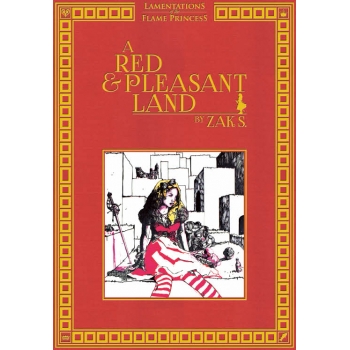
If you have any inkling of OSR stuff you probably know about this one already. Great artwork, great ideas. From my own experiences it's not hugely functional (I've only used the random items table within a game), but it's an exceptional blueprint for how malleable D&D can be. This book is "art" in the sense that it challenges the reader beyond their assumptions of creating and running a game. It is indirectly an instruction manual of how to take your games further. My first encounter with it had me going: "Huh...I never thought of that." Ever since, I've been telling myself to think outside the box more.
4. Yoon-Suin (McGrogan)
This, along with A Red & Pleasant Land is inspirational reading. This setting is laden with tables, and in this sense it is very functional, but again, it challenges me to push the creative envelope with my own endeavours. I doubt I'll ever run a Yoon-Suin campaign, but I may plug it into a game somewhere, or use the adventure generators. More than anything, I just love reading the thing. I'm a huge sucker for Matthew Adams' artwork. Plus slug men.
3. Fever-Dreaming Marlinko (Kutalik)
I play in Chris' G+ campaign so I am a bit biased. But before I knew Chris, I was a fan of the Hill Cantons material. The Hill Cantons Compendium and Slumbering Ursine Dunes are good, but this is Chris' current masterpiece in my opinion. It's short, sweet, and is accurately reflective of how hilarious playing in a Hill Cantons game is. The Slavic influences in his work, as well as his (warped*) imagination/sense of humour are the strong points of this booklet, making it something pretty unique.
2. Gary Gygax's Necropolis
Okay. I ran this badboy around 2003/2004. We played it every weekend for a good six months. There was character death aplenty, horrible traps, terrifying monsters, tricks, traps, the works. This is one of my all time favourite adventures. It's about time I ran it again.
1. Judges Guild Ready Ref Sheets
A very useful set of tools to use with OD&D. Full of vintage vibes, and typewritten amateurism. I like random tables.
So there you go. That's my list. What's yours?
*Describing someone as "warped" in this context is a huge compliment.
Labels:
ASSH,
D&D,
DIY,
Favourites,
Gygax,
Hill Cantons,
Hommlet,
Judges Guild,
Necropolis,
OD&D,
OSR,
Top 5,
Yoon-Suin
Thursday, 20 August 2015
OD&D Conversion
We wrapped up my Astonishing Swordsman & Sorcerers of Hyperborea campaign last night. Perhaps fittingly it was a TPK. A horde of undead overbore the party, and after a cleric-less battle of valorous proportions everyone was dead. Being aware it was the final session, the players decided to fight to the death (though I think they could have escaped if they wished).
After the session I asked the players their thoughts on the system. We've had a total of 14 sessions by my count, which I think is a decent amount to get a handle on a system. People were generally positive with the experience. The two phase combat has been difficult for me to get my head around (practically speaking) and I think this translated in the sessions. Also the descending armour class was different from the games we grew up on (but something I am personally very familiar with). Unsurprisingly, these were the things which were mentioned as downsides. The upsides were the deadliness of combat and the general mood. Let it be noted that the group played excellently throughout this campaign.
I am currently scheming an OD&D sandbox concept. The goal is open-ended exploration, rife with dungeons, cults, interesting wilderness spaces, odd races, spacemen, and everything else that makes a game of D&D fun. My approach is beginning with the White box. Over time I may add some details from the Greyhawk supplement, but for now I'll keep it super simple. Classes will be custom for the most part, though Fighting-Man, Cleric, and Magic-User will be defaults. Given the player feedback regarding descending armour class, I converted the Men & Magic tables to an ascending system. I haven't fully decided whether I'll keep it traditional, or use ascending armour class. Part of me thinks it may be easier (for both me and the players) to use my conversion.
If you're interested check out my downloads page or click HERE.
Print friendly version can be found HERE.
I've attempted to keep the representations faithful to the originals - a literal translation. You'll notice I've created a table which extrapolates the attack bonuses for each level (and class). These are not "raw" because I have had to fill in progressions between say +1 and +3, making an executive decision on how those progressions are made. If you do not like the way I have interpreted this, simply use the preceding tables. In the interest of clarity I have also added the Saving Throws in a more readable format. Hope this is helpful!
Labels:
ASSH,
Conversion,
DIY,
Free,
Greyhawk,
Men & Magic,
OD&D,
OSR,
Tables,
White Box
Thursday, 6 August 2015
Styro City Map (FREE DOWNLOAD).
Today, I've been thinking about cities, and doing them slightly differently in a fantasy game. I doodled the above map today. I like the idea of sci-fi meeting fantasy. The premise being a melding of ancient pyramidical and domed architecture, meeting modern conventions. Think elevator shafts, electronic "magic" equipment, etc. Clearly, there is a visible level above ground, and an undercity rife for exploration.
DOWNLOAD MAP
Points of Interest
Styro can be either an inhabited city, or a seemingly deserted locale. A large building can be located in the wilderness. Leading away from this building, and towards Styro are tall, stone-like creatures (of at least 20 feet in height). These creatures stand erect with arms straight against their sides. Fused to their either side of their heads are two silky cords which act to connect them all in a line extending miles, into the tip of Shaft II's antenna. The creatures do not speak, and may even appear as statues.
In actuality the creatures are psychic conductors. The two cords are known as psychic silk, which can be used to power buildings and technologies. Those endowed with psionic ability can tap into the "silk" and communicate with the connected buildings.
Styro has a few large buildings, and the rest are fairly humble domiciles. Of note is the Ramid, Babel, the Silo, and the dual shafts.
The lower levels and monsters are not detailed. I may run my group through this adventure site (if they find it!), and do not wish to ruin any surprises. Depending on my ongoing enthusiasm I may release this as a proper adventure. Enjoy.
1. Shaft I
- 120 feet deep, 6 feet wide.
- After 60 feet an entry into Gamma (Level 3) may be visible.
- A winch-wound shaft and basket enables descent.
- Service entries can be found on either side of shaft, for maintenance or surprising foes.
- The building housing the shaft has strange blinking lights within, and a perpetual rumbling noise.
- Opening the rumbling cages reveals sluggish creatures sitting in pits of putrid goo. The goo glows with a phosphorescence, and seems to power the infrastructure.
2. Silo
- 40 feet high.
- Appears as an administration office — various abacus', merchants' scales, astronomical tools, and so forth can be found within.
3. Ramid (Temple)
- 80 feet high. Can be ascended by climbing its stepped sides.
- Has an unusual pole atop.
- Inside is a catacomb of worship avenues, shrines, sacrificial altars, mission quarters, and channels of cut recesses within the floors.
- The temple interior is divided into 3 levels, each 20 feet high.
- A crypt of monkey-sarcophagi.
- A shaft descends into Alpha (Level 1).
4. Shaft II
- 120 feet deep, 6 feet wide.
- At the bottom an entry into Zeta (Level 6) can be discovered, though the portal is locked.
- Alternatively another descent into Shaft III can be discovered. Though descending this requires manipulation of an ensorcelled device.
5. Babel
- A tower — 60 feet high at its pinnacle, 20 feet wide.
- Murals on most walls depicting a slave-people toiling to erect this structure. The exterior resembles the Empire State building somewhat.
- The appointments within suggest a matriarchy society, led by Queen lineage.
6. Domiciles
- Simple structures of varying sizes and shapes. Most are single or double-roomed, while others are rather palatial.
- Squarish or domed.
- A few will have treasure.
7. Shaft III
- 70 feet deep, 6 feet wide.
- Getting up or down requires manipulation of an ensorcelled device (powered by the slugs or the Giant Rockdweller psychic silks).
8. Alpha (Level 1)
- Vaulted ceilings 20 feet high.
- This level is 60 feet high.
- This level is 40 feet high.
Labels:
Adventure,
Campaign,
Cartography,
City,
Corey Ryan Walden,
DIY,
Dungeons & Dragons,
Exploration,
Maps,
OSR,
Sandbox,
Styro
Saturday, 1 August 2015
Sandboxing (A Work In Progress)
I've decided to compile a growing collection of tables into one booklet. The purpose: to assist with an upcoming hexcrawl/megadungeon/sandbox campaign I'm working on. Maybe other people will enjoy them too. I've already published three of these to my blog, but I've attempted to tidy them up somewhat in a slightly more professional manner.
The booklet is aptly entitled "Sandboxing". I will continue to add new tables to the booklet, as I create them. It will be available exclusively (for the moment) from my downloads page. If it grows to a publishable size, I may look at making a print-on-demand version available. If you like it, keep checking back. This is a long-term project, and I have two other projects of much higher priority, but I do hope to keep plugging away at it over the next year or two.
Get it directly from HERE or check out my downloads page.
Friday, 17 July 2015
The Unpredictabilities of Role-Playing
The last few weeks have seen the end of my Anthropophagi of Xamboola playtest. Overall I was pretty happy with how it ran, and of course, there are plenty of amendments to include. When designing the town/city of Xamboola I believed it would be somewhere the party would want to stay for an elongated period of time. I thought it had everything they needed. There were bits of "the old city" they had not explored, as well as some more localised adventuring possibilities. Surely that would keep them entertained.
Anyway, in the true fashion of a pack of vagrants they did the exact opposite of what I expected — travelling for two weeks to the nearest city of Yithorium (it's in the ASSH universe for those who care). Hey, they wanted some magic ID'd! Luckily I had a couple of mini-encounters already up my sleeve, but the city itself was a completely untouched area.
There has been one theme or idea that has been very resonant with me lately. It actually was a learning curve that eventuated from designed the Xamboola adventure. Basically, I read a kickass Conan story, and it was filled with so much vibe I needed to game it. The idea that I've been kicking around lately — and I've seen it discussed on a few blogs too — is simple: begin with a vibe. For me, Howard's action-packed prose was all it took to get the first ideas on paper, and the whole thing snowballed from there. How does this relate to my first anecdote? Glad you asked.
I was presented with a similar situation on Wednesday night. Basically I had a pretty distinct vibe of what Yithorium was like. There was a bit of gazetteer information on it, but the rest was a distinct mental image residing in my imagination. As a DM/Ref I have never been great at running games on-the-fly. I excel when I've thought about things, planned encounters, giggled to myself at the NPCs that emerge from my warped brain. But generally there is a level of preparedness that goes into my running of games.
In an attempt to be more comfortable with the unknown, and with a looser style of play, I have begun writing tools to assist with this process. Some of you may have seen/downloaded the first three of my NPC Toolkits. I had those at the table with me. I was surprised at how well some random dice rolling worked in creating two distinctive NPCs. The adventurers had been lured to Yithorium mainly to get rid of accumulated wealth and items, but they had also heard some strange rumours from Xamboola. With that barest framework a large portion of the session was essentially ad lib — or rather, unplanned. I had no idea what was to eventuate, but the narrative sort of naturally unfolded. One of the PCs wanted to enquire about the strange rumours. Others wanted to hunt for magic-users. I used a table to roll up an inn. Ideas emerged through role-playing: a strange concept for the town guards, and the city's mores and values. After the session my brain was alive with creativity and more ideas came to me to develop for next time.
My point, I guess, twofold:
1. I need to make more tables!
2. It's really amazing what happens when your plans go out the window.
This is probably nothing new to most (or all) of you, but it was a nice reminder to plan a little more loosely. I had an entirely different adventure planned, but I'd rather give the players autonomy. Now, time to get back to the adventure writing.
Anyway, in the true fashion of a pack of vagrants they did the exact opposite of what I expected — travelling for two weeks to the nearest city of Yithorium (it's in the ASSH universe for those who care). Hey, they wanted some magic ID'd! Luckily I had a couple of mini-encounters already up my sleeve, but the city itself was a completely untouched area.
There has been one theme or idea that has been very resonant with me lately. It actually was a learning curve that eventuated from designed the Xamboola adventure. Basically, I read a kickass Conan story, and it was filled with so much vibe I needed to game it. The idea that I've been kicking around lately — and I've seen it discussed on a few blogs too — is simple: begin with a vibe. For me, Howard's action-packed prose was all it took to get the first ideas on paper, and the whole thing snowballed from there. How does this relate to my first anecdote? Glad you asked.
I was presented with a similar situation on Wednesday night. Basically I had a pretty distinct vibe of what Yithorium was like. There was a bit of gazetteer information on it, but the rest was a distinct mental image residing in my imagination. As a DM/Ref I have never been great at running games on-the-fly. I excel when I've thought about things, planned encounters, giggled to myself at the NPCs that emerge from my warped brain. But generally there is a level of preparedness that goes into my running of games.
In an attempt to be more comfortable with the unknown, and with a looser style of play, I have begun writing tools to assist with this process. Some of you may have seen/downloaded the first three of my NPC Toolkits. I had those at the table with me. I was surprised at how well some random dice rolling worked in creating two distinctive NPCs. The adventurers had been lured to Yithorium mainly to get rid of accumulated wealth and items, but they had also heard some strange rumours from Xamboola. With that barest framework a large portion of the session was essentially ad lib — or rather, unplanned. I had no idea what was to eventuate, but the narrative sort of naturally unfolded. One of the PCs wanted to enquire about the strange rumours. Others wanted to hunt for magic-users. I used a table to roll up an inn. Ideas emerged through role-playing: a strange concept for the town guards, and the city's mores and values. After the session my brain was alive with creativity and more ideas came to me to develop for next time.
My point, I guess, twofold:
1. I need to make more tables!
2. It's really amazing what happens when your plans go out the window.
This is probably nothing new to most (or all) of you, but it was a nice reminder to plan a little more loosely. I had an entirely different adventure planned, but I'd rather give the players autonomy. Now, time to get back to the adventure writing.
Tuesday, 7 July 2015
Tombstone: Wild West RPG Update
Work continues to progress on Tombstone - sometimes quickly, sometimes slowly. I have been editing and amending the alpha rules, and tidying up various inconsistencies. I hope to have a playtest version ready by the year's end (if not sooner).
Today I received a gorgeous town map of Silverton from +Joe Salvador. Joe has been doing an outstanding job capturing the grittiness and mood I've been attempting to create within Tombstone. His work nicely complements Erik Wilson's commissioned artwork, and at least from a artistic perspective, I can confidently say this game is going to look great!
Here's a preview of Joe's Silverton map. If you have not already, I'd suggest you follow Joe for updates, and head over to his blog to check out his existing work. He is a great game designer in his own right, and has a published module in the new Astonishing Swordsmen & Sorcerers of Hyperborea Kickstarter adventures.
In a month or so I plan to run some G+ playtests of Tombstone, so if you're interested in that, stay tuned...
Sunday, 5 July 2015
Blueholme Prentice Rules: Review
Author: Michael Thomas
Price: $0.00/$9.99 (DriveThruRPG/Dreamscape Design)
Format: PDF/Print
Page count: 57
System: Dreamscape Design
Year: 2014
I will be transparent: I do not own Dungens & Dragons Holmes (unless a PDF copy counts). Over the past two years the retro-allure has certainly tempted me. Ebay's nightmarish, and often extortive shipping prices to New Zealand have inevitably prevented this however. When +Michael Thomas released the Blueholme Prentice rules I was interested by the potential of this ruleset, particularly if it was rules-light and representative of Holmes. My personal dealings with Michael have been very positive - he is a nice guy, always willing to chat - and he was generous enough to mail me a physical copy for review (which doesn't often happen!).
It should be apparent to anyone vaguely acquainted with my writing that I enjoy OD&D and B/X Basic. The freewheeling aspect of these editions is appealing; particularly the minimal preparation required, and the maximum potential for fun. Historically the Basic Set emerged with the purpose of introducing new players to the hobby, and going to some lengths to clarify the existing OD&D rules. Assuming Blueholme cleaves closely to the original Holmes rules (warranting a "retroclone" status), I expected a simple and transparent system, while being representative of the original texts.
The purpose of this review is not a study the minute similarities and differences between Holmes and Blueholme. Rather, the purpose is a subjective impression of the game as a standalone system. Of course, this review cannot help being informed by the primary inspiration of this system, so some comparison to Holmes will inevitably occur.
The Good
I'm a sucker for a good cover. Undoubtedly one of the biggest appeals of Blueholme is the awesome cover art by Jean-Francois Beaulieu. It captures the essence of the Holmes set nicely with its iconic blue cover. The dragon is very reminiscent of the original, yet the whole piece is a satisfying homage without being a pedant to history. I've previously discussed my disdain for OSR products that are slavishly reminiscent of TSR's yesteryear. I like that the Blueholme cover deviates from tradition in a fun way. Its is not a kitsch or tacky try-hard attempt to invoke nostalgia, but the roots of inspiration are transparent. I will talk about the artwork later, but suffice to say, I adore the cover.
Blueholme's true strength is its vivid and crystalline presentation. The table of contents provide excellent oversight, fitting into a single page. The introduction is a brief synopsis of the booklet and welcomes the reader to dive right in. I cannot praise the simplicity and alacrity of writing enough. In my opinion it is very eloquent, forgoing many of the arduous textbook conventions of a role-playing game. Blueholme Prentice does not require mental exercise to grok the contents, to flick between pages with a confused frown, or to toil through pages of dry and uninspired text.
These rules are designed to quickly consult amidst the flurry of an exciting game, rather than being an encyclopaedic reference work one is required to memorise with fastidious dedication. This is a workman's D&D. This is Blueholme's obvious appeal. Tables, charts, explanations and descriptions are executed with the mantra of concision and explication in mind. For this reason I eagerly anticipate the Blueholme Compleat rules. If Compleat is accessible as Prentice, I believe it will be an excellent edition. My proclivity and adoration for OD&D probably influences this belief somewhat!
Character creation is a simple process in Blueholme, representative of the ethos of early D&D. Thomas has designed Blueholme to be even more accessible than the original texts, which is an added bonus. This is surely the strong point of the game.

The example character sheet (pictured left) is indicative of the simplicity of creating characters.
This is a no frills approach to D&D. If you're looking for a system that enables quick play and practicality, Blueholme excels. Some gamers may be deterred by the brevity and interpretative nature of the system, but I perceive it to be a selling point.
Let me be clear that I do not have a go-to edition of D&D. I'm an edition whore. Sometimes I like playing a granular system like AD&D, AS&SH or 3e. Sometimes I want a quick rules-lite game of OD&D or B/X. Sometimes I want an in-between like 5e or Savage Worlds. Prentice firmly inhabits the rules-lite camp, and is a viable candidate for classic styled games.
The Bad
My largest complaint with the Blueholme Prentice rules is the almost exclusive usage of common domain images. For the indie designer on a budget, this is often a necessary design choice, and one I fully understand.
However I cannot shake the feeling that the assortment of images chosen to "fit" the system only make-do rather than convince me of an over-arching flavour in a satisfying way. What do I mean by this? If the cover artist had illustrated this entire booklet I would be in love with Blueholme. The cover image invites excitement and imagination, reminiscent of early editions, while the interior art does not fit a cohesive theme (besides being public domain). In this way the presentation seems somewhat confused or disappointing at times.
Of course this necessarily raises a larger question of designer sustainability, and one's ability to afford up front the costs needed to generate new products. In short I would have liked the layout and interior artwork to be commissioned. Consequently I would be holding a truly inspiring product. I understand the upcoming Blueholme Compleat rules will be filled with commissioned artwork and this is an excellent decision, hopefully extending to commissioned layouts and graphic design too.
A secondary critique which is slightly unfair, is that Blueholme Prentice is only for levels 1-3. One is referred to the Compleat rules if one wishes for higher levels, much like Holmes referred the reader to AD&D. This is a minimal issue for a number of reasons:
1. Prentice professes to adhere to Holmes (which was only levels 1-3). Therefore why would it go beyond 3rd level? That is what Compleat is for.
2. The PDF of Prentice is a free download. Think of it as a taster, if you enjoy Prentice and/or want additional levels graduate to Compleat.
3. Short campaigns needn't exceed the first 3 levels of play (in fact I remember reading somewhere that Eric Holmes' campaigns rarely surpassed 3rd level).
Some readers/players may find this an annoyance (and was probably a factor that detracted from TSR's Holmes). If your campaigns are centred around the first 3 levels of play, or you are frequently gaming one-shots, I would recommend you seriously consider using Prentice rules as your go-to (but please, more artwork from Jean-Francois Beaulieu!).
Final Thoughts
Blueholme Prentice is an imaginative tool. It captures the spirit of early D&D, which is about adjudication rather than minute rules-lawyering. It offers a palette of options, rather than dictums. It is clear, concise, and utterly gameable. I can imagine porting my own house rules and class variants to Blueholme with no problems. I'm very much looking forward to Compleat, which promises to surpass Prentice's shortcomings (level limitations and the detracting public domain artwork). An entire book filled with commissioned artwork will be awesome.
By all means pick up a free PDF copy of Blueholme Prentice. Pay for a physical copy if this review has ticked your requirements for a pick-up game. Besides clarifying the ambiguities of Holmes, this product makes no attempt to expand on the original. This is purposeful, and firmly situates it as a true retroclone.
I plan to run an adventure or two using Blueholme, and who knows, it may even replace my habit of using B/X for one-shots. It's a ruleset I won't mind thrashing because that's what it's designed to do: be gamed.
Price: $0.00/$9.99 (DriveThruRPG/Dreamscape Design)
Format: PDF/Print
Page count: 57
System: Dreamscape Design
Year: 2014
I will be transparent: I do not own Dungens & Dragons Holmes (unless a PDF copy counts). Over the past two years the retro-allure has certainly tempted me. Ebay's nightmarish, and often extortive shipping prices to New Zealand have inevitably prevented this however. When +Michael Thomas released the Blueholme Prentice rules I was interested by the potential of this ruleset, particularly if it was rules-light and representative of Holmes. My personal dealings with Michael have been very positive - he is a nice guy, always willing to chat - and he was generous enough to mail me a physical copy for review (which doesn't often happen!).
It should be apparent to anyone vaguely acquainted with my writing that I enjoy OD&D and B/X Basic. The freewheeling aspect of these editions is appealing; particularly the minimal preparation required, and the maximum potential for fun. Historically the Basic Set emerged with the purpose of introducing new players to the hobby, and going to some lengths to clarify the existing OD&D rules. Assuming Blueholme cleaves closely to the original Holmes rules (warranting a "retroclone" status), I expected a simple and transparent system, while being representative of the original texts.
The purpose of this review is not a study the minute similarities and differences between Holmes and Blueholme. Rather, the purpose is a subjective impression of the game as a standalone system. Of course, this review cannot help being informed by the primary inspiration of this system, so some comparison to Holmes will inevitably occur.
The Good
I'm a sucker for a good cover. Undoubtedly one of the biggest appeals of Blueholme is the awesome cover art by Jean-Francois Beaulieu. It captures the essence of the Holmes set nicely with its iconic blue cover. The dragon is very reminiscent of the original, yet the whole piece is a satisfying homage without being a pedant to history. I've previously discussed my disdain for OSR products that are slavishly reminiscent of TSR's yesteryear. I like that the Blueholme cover deviates from tradition in a fun way. Its is not a kitsch or tacky try-hard attempt to invoke nostalgia, but the roots of inspiration are transparent. I will talk about the artwork later, but suffice to say, I adore the cover.
Blueholme's true strength is its vivid and crystalline presentation. The table of contents provide excellent oversight, fitting into a single page. The introduction is a brief synopsis of the booklet and welcomes the reader to dive right in. I cannot praise the simplicity and alacrity of writing enough. In my opinion it is very eloquent, forgoing many of the arduous textbook conventions of a role-playing game. Blueholme Prentice does not require mental exercise to grok the contents, to flick between pages with a confused frown, or to toil through pages of dry and uninspired text.
These rules are designed to quickly consult amidst the flurry of an exciting game, rather than being an encyclopaedic reference work one is required to memorise with fastidious dedication. This is a workman's D&D. This is Blueholme's obvious appeal. Tables, charts, explanations and descriptions are executed with the mantra of concision and explication in mind. For this reason I eagerly anticipate the Blueholme Compleat rules. If Compleat is accessible as Prentice, I believe it will be an excellent edition. My proclivity and adoration for OD&D probably influences this belief somewhat!
Character creation is a simple process in Blueholme, representative of the ethos of early D&D. Thomas has designed Blueholme to be even more accessible than the original texts, which is an added bonus. This is surely the strong point of the game.

The example character sheet (pictured left) is indicative of the simplicity of creating characters.
This is a no frills approach to D&D. If you're looking for a system that enables quick play and practicality, Blueholme excels. Some gamers may be deterred by the brevity and interpretative nature of the system, but I perceive it to be a selling point.
Let me be clear that I do not have a go-to edition of D&D. I'm an edition whore. Sometimes I like playing a granular system like AD&D, AS&SH or 3e. Sometimes I want a quick rules-lite game of OD&D or B/X. Sometimes I want an in-between like 5e or Savage Worlds. Prentice firmly inhabits the rules-lite camp, and is a viable candidate for classic styled games.
The Bad
My largest complaint with the Blueholme Prentice rules is the almost exclusive usage of common domain images. For the indie designer on a budget, this is often a necessary design choice, and one I fully understand.
However I cannot shake the feeling that the assortment of images chosen to "fit" the system only make-do rather than convince me of an over-arching flavour in a satisfying way. What do I mean by this? If the cover artist had illustrated this entire booklet I would be in love with Blueholme. The cover image invites excitement and imagination, reminiscent of early editions, while the interior art does not fit a cohesive theme (besides being public domain). In this way the presentation seems somewhat confused or disappointing at times.
Of course this necessarily raises a larger question of designer sustainability, and one's ability to afford up front the costs needed to generate new products. In short I would have liked the layout and interior artwork to be commissioned. Consequently I would be holding a truly inspiring product. I understand the upcoming Blueholme Compleat rules will be filled with commissioned artwork and this is an excellent decision, hopefully extending to commissioned layouts and graphic design too.
A secondary critique which is slightly unfair, is that Blueholme Prentice is only for levels 1-3. One is referred to the Compleat rules if one wishes for higher levels, much like Holmes referred the reader to AD&D. This is a minimal issue for a number of reasons:
1. Prentice professes to adhere to Holmes (which was only levels 1-3). Therefore why would it go beyond 3rd level? That is what Compleat is for.
2. The PDF of Prentice is a free download. Think of it as a taster, if you enjoy Prentice and/or want additional levels graduate to Compleat.
3. Short campaigns needn't exceed the first 3 levels of play (in fact I remember reading somewhere that Eric Holmes' campaigns rarely surpassed 3rd level).
Some readers/players may find this an annoyance (and was probably a factor that detracted from TSR's Holmes). If your campaigns are centred around the first 3 levels of play, or you are frequently gaming one-shots, I would recommend you seriously consider using Prentice rules as your go-to (but please, more artwork from Jean-Francois Beaulieu!).
Final Thoughts
Blueholme Prentice is an imaginative tool. It captures the spirit of early D&D, which is about adjudication rather than minute rules-lawyering. It offers a palette of options, rather than dictums. It is clear, concise, and utterly gameable. I can imagine porting my own house rules and class variants to Blueholme with no problems. I'm very much looking forward to Compleat, which promises to surpass Prentice's shortcomings (level limitations and the detracting public domain artwork). An entire book filled with commissioned artwork will be awesome.
By all means pick up a free PDF copy of Blueholme Prentice. Pay for a physical copy if this review has ticked your requirements for a pick-up game. Besides clarifying the ambiguities of Holmes, this product makes no attempt to expand on the original. This is purposeful, and firmly situates it as a true retroclone.
I plan to run an adventure or two using Blueholme, and who knows, it may even replace my habit of using B/X for one-shots. It's a ruleset I won't mind thrashing because that's what it's designed to do: be gamed.
Labels:
Blueholme,
Compleat,
D&D,
DIY,
Dungeons & Dragons,
Holmes,
Michael Thomas,
OD&D,
OSR,
Prentice,
RPG
Saturday, 27 June 2015
NPC Toolkit Tables
Over the next few months I'll be working on a booklet (that may turn into a book) of NPC-related tables. Of course, this may even expand into something bigger. I already have some ideas of where this whole project could progress, but I am fundamentally interested in creating a set of useful tools that can be used in-game to quickly generate ideas.
My tables follow a d100 design thus far - because the more ideas the merrier right? Other tables may not follow this progression, but for now they will. I released my "Dispositions" table earlier this week, but I have added another two to the complement:
1. NPC Appearance Table
2. NPC Professions Table
Both can be found under the "Downloads" tab on my blog. I will hopefully make time to update and add to these tables over the coming weeks and months, eventually providing a whole package of tables.
Happy gaming!
My tables follow a d100 design thus far - because the more ideas the merrier right? Other tables may not follow this progression, but for now they will. I released my "Dispositions" table earlier this week, but I have added another two to the complement:
1. NPC Appearance Table
2. NPC Professions Table
Both can be found under the "Downloads" tab on my blog. I will hopefully make time to update and add to these tables over the coming weeks and months, eventually providing a whole package of tables.
Happy gaming!
Tuesday, 23 June 2015
NPC Dispositions Table - D100
_____________________________________________________
NPC Dispositions Table
I. This table can be used to determine an NPC’s personality or traits.
II. This table can be used during a chance encounter, or for a known NPC’s ephemeral reaction or current mood.
III. Roll 1d100 and match the result to the table below; this is the NPC’s disposition.
IV. Repeat to your heart’s content.
Subscribe to:
Posts (Atom)