Thursday, 12 May 2016
The Black Hack: Mini Review for a Mini Game
PDF: $2.00
Physical: £4.00+
Over the past few weeks my G+ feed has been raging about David Black's new game The Black Hack. "I don't need another system or clone", I told myself, "the hype will die down". But then I kept hearing good things and realised I had some publisher's credit on DriveThru RPG. The price-tag for the PDF is only $2.00, so I thought, "why the hell not?". I downloaded the PDF and began reading. It is only 20 pages long, which is astonishingly short for an entire system. I was immediately impressed.
The Black Hack is an innovative RPG publication. It reconceptualises Dungeons & Dragons, distilling it to its rawest essence, while offering some inspired rules variants. At times the simplicity threw me: "this can't be it?". But it is. I think the minimalism would put some people off, the spartan style is not for everyone. Those new to the hobby – those learning the game for the first time – might, I imagine, find the esoteric nature of the The Black Hack ruleset problematic. The writing implies that the reader has prior experiences with role-playing games. Having said that, it would be an excellent option for teaching the game to new players (assuming the GM has prior experience). Reading through the booklet makes me want to run a game. It is simple, elegant, and improves some of the flaws of D&D without forsaking what makes the game great. It would also be useful as an options booklet for existing systems. I could imagine using the torch/rations/ammunition rules in any edition of D&D: it's easier than the traditional way of doing things. If you are looking for an ultra rule-lite RPG, this is a great purchase.
Buy it: if you like rules-lite systems.
Avoid it: if you froth over Runequest or Pathfinder.
Sunday, 24 January 2016
Review: Wormskin No. 1
Wormskin No. 1 (Autumn 2015)
Author: Norman & Gorgonmilk
System: Labyrinth Lord (or similar)
PDF/Print: $3.00 / $5.75
It has been a solid three months since I last posted anything. Nonetheless, I have been busy on a number of projects, both gaming related and otherwise. It is shaping up to be a good year.
Before Wormskin was released I remember +The Real-ish Greg Gorgonmilk posting some compelling WIP shots of the cover and interior maps. That, combined with the professed tone and inspiration of the work — folklore and the fairy tale — sustained my curiosity. Consequently, when it was released recently as a print-on-demand product I decided to purchase the first issue of the zine.
The back cover of Wormskin ostensibly claims to explore:
"...the mythic forest called Dolmenwood, a setting for use with B/X campaigns or similar tabletop systems. Each issue will look at various elements of this eldritch realm situated on the leafy verges of Faerie, where austere Drunes rub elbows with weird elf-lords and talking beasts, where witches wander skyclad and armed with sinister magicks to bind the spirits of hapless adventurers. Be wary."
While in a very abstract sense this is true, much of the 41 pages are dedicated to two new race-as-classes (Moss Dwarf and Grimalkin), detailing thirty variety of fungi within Dolmenwood, and presenting a new monster. There is a two-page map of the area, but it scarcely describes anything canonical of the actual setting — "Drunes", "weird elf-lords", or indeed anything much about the kingdoms or environs within the setting. Personally I would like to see more of the pages of future issues dedicated to exploring this very thing.
With that quibble confessed let me tell you about the things that Wormskin does well. While the text may not explicitly say a whole lot about the setting of Dolmenwood it does imply a lot through the articles within the zine. Overall I appreciated the mood; it fits well with the assumptions of my own campaign world, and there was enough within its 41 pages that I can borrow or transplant to the gaming table.
The zine is attractively presented; Gorgonmilk (I presume) has managed to curate the content in an attractive and legible manner. The (public domain?) illustrations fit the theme of Dolmenwood and +Matthew Adams provides a number of pieces, quintessential of his offbeat and slightly creepy style. Andrew Walter is credited with a coloured piece of the moss dwarf which I really enjoyed. The whole work is latticed with small decorative flourishes, like pictures of 'shrooms and the occult-inspired title page.
The contents provide a reasonable bang for buck. The moss dwarf is an interesting class; I am unsure whether they would be better suited as an NPC (indeed, the "Moss Dwarf NPCs" table is rather inspired), but I can also imagine them being fun to play in a wilderness campaign. The Grimalkin class is imaginative too. It seems to draw upon a similar mythological antecedence to my own Werecat class, but fits within the implied assumptions of the Dolmenwood campaign very tidily.
The section on fungi is an entertaining and practical addition because detailing specific flora is something I frequently overlook in my own milieux. Providing a wide selection of edible, poisonous, and psychotropic mushrooms adds a compelling layer of realism and richness to any world, and I will probably use this section more or less verbatim at the table. Within these three articles the reader catches glimpses of Dolmenwood: witches, woodsmen, poisoners, "demi-fey", "dank woods", and a relationship with the ephemeral Otherworld. As noted previously, this is something I would like to have seen developed more explicitly, or most certainly in future issues.
In sum, Wormskin is worth the money. Whether you are picking up the PDF or a physical copy, there will probably be something of interest if you enjoy new rules and a zine whose setting is seeped primarily in folklore and fable.
Wednesday, 28 October 2015
Campaign Languages
Since beginning my OD&D sandbox it became apparent
that I needed to define the languages used within my world. The reason for this
was twofold. First, a reasonable intelligence grants a shit-ton of known
languages using the OD&D rules. Second, it was an excuse for me to better
define the various races and creatures within my milieu. Superficially
this was an easy task. Creating a list took 10 minutes or so. But deciding to
go beyond that beginning point, and go into a bit more detail took much
longer. The following text contains my current languages list, with a
description for each one. With something like Majick Script or Runic, I would
probably offer an intelligence roll based on the character's % to know
spells. If the percentage chance was too high (considering the obscurity of the
text), I would reduce this to half or one quarter.
Languages
Avakin: The written
and spoken Avakin language is eponymous with the southern folk who conquered Suthræm[1]
some centuries past. Avakin is now the primary language of the south, in
addition to being the antecedent language from which the Trade Cant was
derived. Fluency in Avakin enables a speaker to accurately converse with the
Avakin people. Those fluent in the Trade Cant will also be able to communicate
with Avakins, albeit inexactly.
Chaos [Darkling]: Devotees of
malignance, anarchy, and ruin may learn the darkling language. Many fell
creatures know this forbidden tongue, passed on through the aeons. Beings who share
a similar ethical paradigm can use this “language” to crudely communicate with
one another. Opponents of chaos will find its utterance wholly repulsive.
Common [Trade Cant]: A trade
language spoke throughout the continent. Its linguistic foundations are mostly derived
from Avakin. Although the Trade Cant has become bastardised, those able to
speak it can commune in approximate terms with Avakins, as the language still
holds much similarity.
Druidic [Secret]: Once the spiritual
tongue of the continent, the language of the druids has now become rare and
secretive. Those “chosen” by the old gods may learn Druidic; it is useful for learning
and enacting hidden rites. Isolated or cultic sects of Wæld and Væya still speak Druidic, but
most will speak an offshoot.
Ecclesia
[Priestly]: Devout and educated followers of Avagæd[2]
study and speak the dialect of Ecclesia: namely priests, friars, monks, and
knightly Templars. The most sacred texts of Avagæd
are written in Ecclesia, therefore serfs are unlikely to speak or understand it,
though the elite of Avakin society might.
Exterst: Save
for some rare artefacts inscribed with alien symbolism, the “language” of
Exterst would be all but a myth. For over a half-millennia, remnants of
unknowable apparatus have been unearthed in south-western Nozræm[3].
It is dubious whether anyone actually speaks an Exterst language, but at one
point in history it is almost certain that such a people and language existed.
Frog-Man: Consisting
mainly of croaks and groans, the tongue of the Frog-Man is primordial and
hardly the subject of worthwhile scholarly pursuit. Those in or near swamp-like
environments might learn this language, mostly borne from necessity, for to ignore
a Frog-Man is to invite death. Some depraved human hunters yearn for the taste
of Frog-Man flesh, learning the language in order to eavesdrop and discern when
the ripest younglings will be born.
Grekon: This is the chief
language spoken by the people of Nozræm. Spoken
Grekon is still prolific in the North, though centuries of Avakin conquest has
caused this language to ebb; the Trade Cant has become prominent as the standard
mode of communication.
Hillfolk: Dwelling
within crags, mountains, badlands, and desert locales, the stunted Hillfolk
speak their own language. Disparate from the flatter (and arguably tamer) areas
of the continent, the Hillfolk language has drastically evolved from other
spoken tongues. Interestingly, there are hundreds of divergent sub-dialects
based on one’s tribe and location.
Law: Guardians of
order, establishment, and munificence can use a variety of shared conventions
to interact, broadly conveying a sense of commonality and intuited meaning. Opponents
of law will find such utterances platitudinous and vapid, filled with tiresome
clichés and moralistic inanities.
Majick Script [Secret]:
Some
advanced scholars have gained a cursory knowledge of the mind-bending symbolism
of Majick. However, thorough knowledge of this language is reserved for true
practitioners of Majick, enabling them to decipher unknown scripts. Dabblers with
lesser knowledge may glean an overall notion of what a text contains, but they will
remain unable to release the latent Majick unless their skillset somehow allows
them.
Neutrality: Those possessing
neither the unbridled whim of chaos, nor the considered gravity of a lawful
society, may share a common sense of neutrality. Two beings of a neutral paradigm
can broadly converse with one another, using certain words or non-verbal
patterns. Extremists of law or chaos will experience this communication to
either radical on the one hand, or insipid on the other.
Runic: Anyone
learned in runic scripting will be able to roughly discern abstracted visual
messages contained on the surfaces of carven rocks, tombs, road markers,
parchments, and so on. Runic writing is derived from Druidic, which in turn was
derived from Wæld and Væya. Although a derivative,
unless a reader has taken care to learn the nuances of this written language,
the original intent will be nigh indiscernible.
Swamp-Tongue: The
Swamp-Tongue developed as bog denizens deigned value in trading, staking
boundaries, and engaging in parlay. While primitive, it is the primary language
of the bizarre Quagkings. Some evolved Aquatic Apes have finally grasped the basest
rudiments of this simple language. Even Frog-Men have seen the necessity for
communicating in this language. Swamp-Tongue is mainly comprised of clicks,
grunts, animalistic noises, hoots, belches, and the crudest elements of old Druidic.
There is no written form of Swamp-Tongue besides a handful of symbols, most of
which signify dangerous sinkholes or food-traps.
Thieves Cant [Secret]: Thieves and
assassins congregate in their guilds, meeting halls, and in the subterfuge of
dark places. Their secret cant, useful for enacting chicanery, is comprised of
hand signals, passwords, double-entendres, pitched whistles, odd noises, curious
symbols, and a political doublespeak capable of conveying multitudinous
messages. Some non-thieves may learn a few aspects of this “language”, but the
cant is heavily guarded and secretive, with passwords prone to regular change.
Væya: Perhaps the most ancient language, Væya is undoubtedly the most pleasant to behold.
Although akin to the Wæld language, it is much less
harsh and guttural. In written form, Væya is striking and complex, forming the
basis from which Majick and Runic scripting developed, and from which the
spoken language of Druidic eventually evolved.
Wæld: The spoken language of Wæld is harsh and guttural. Wæld
forsakes the elongated and softer vowel sounds of
Væya, dropping certain words from its dialect entirely. It would be incorrect
to suggest Wæld is an unintelligent
language. Instead, like the culture it represents, two words are avoided when
one will suffice.
Tuesday, 27 October 2015
Review: Rogues in Remballo (Swords & Wizardry)
Rogues in Remballo: An Adventure for Swords & Wizardry
Author: Matt Finch
Character Levels: 1st
System: Swords & Wizardry (or similar)
PDF: Free!
Print: Kickstarter
When +Matt Finch asked for reviews of this adventure I put my hand up. I had recently acquired the hardcover of Swords & Wizardry Complete (which I really like) so I was eager to see what a city adventure may look like within this system.
I had every intention of writing/posting this earlier, but I have been kind of slack. Now that I've finally read through the adventure and given it some thought, here we are. Before I begin I want to mention two things. Firstly, this adventure is available as a free PDF from the Frog God Games website (link above). Secondly, there is an in-progress Kickstarter where one may acquire this adventure in print form as part of the larger "Borderlands" project. If this review stokes your interest I would recommend downloading the free copy first. It has been produced in black & white, making it printer-friendly. If you absolutely love it, and like the look of the Kickstarter (link above) you may wish to back the Kickstarter and get a print version.
Anyway, let's begin. Rogues in Remballo (hereafter referred to as "Rogues") is a city-based adventure of political intrigue. Finch suggests this adventure is suited for experienced groups, and I can see the logic behind this suggestion. While less experienced groups could probably handle the intricacy and relative open-endedness of the adventure, the skill required on the part of the players (and certainly the Ref) is better suited for gamers with a number of adventures/campaigns under their belt. Having said that, one of the first adventures I ran was The Speaker In Dreams which contains a similar level of nuance. Regardless, there is soundness in Finch's suggestion. In the unlikely event that you are reading this and have never run a game of Dungeons & Dragons or Swords & Wizardry, I would be inclined to echo Finch's advice. Pick something simpler. For true beginners, the 5th Edition Starter Set is not a bad way to go. But I digress.
Rogues is set within the Borderland Provinces of the "Lost Lands" setting. At times there were references to setting specific elements not explained within the adventure, but largely the adventure site would be easy enough to transplant to any setting. From the outset the reader is provided with some clear and functional maps of Remballo, keyed with particular sites of interest. This city could be placed in most generic fantasy settings, or with a bit of tweaking, would fit nicely in more eclectic realms. The setting does assume a relative level of technological sophistication (such as banking systems/letters of credit), so these aspects may need modification if your setting is more primitive.
The main contention of the adventure revolves around two powerful forces within the city: The House of Borgandy (who have had one of their own disappear) and the local Thieves Guild. Additionally there are some other major forces at work, particularly the Thieves Guild of Manas and the City Watch. This adventure is largely non-linear, though there is a logical progression between beginning and end which is likely to coalesce in a number of possible outcomes: beginning within the walls of the city, progressing to an area called "The Four Corners", and reaching climax beneath the city itself. What happens in between is largely up to the detective work of the players/characters, and without skilful implementation by the Ref, this adventure could quickly become directionless or somewhat vague. At times this adventure appeared to be an exercise in door-knocking: "Hello sir, could I bother you for a second? Oh, you don't know anything about this event? Okay, well good day." As some of the NPCs were described as grumpy, this may deter players, appearing to be a dead-end approach to discovering the required information. I suspect that the adventure could have been signposted a little better. There are, however, a number of compelling motivations to get the participants interested in the adventure — including the classic incentive of gold payable from the coffers of The House of Borgandy and the local Thieves Guild. Smart or lucky players will be able to double dip and capitalise on the rewards of both. There is room for deviancy too, particularly towards the end where certain...goods...can be "acquired" from certain (probably dead) individuals. Finch provides a satisfying level of detail regarding the political factions within and without the city. This inclusion creates a satisfying and believable backdrop from which to hinge the whole affair. At this point I won't give too much away, lest I spoil the adventure if you wish to play/run it.
The setup and presentation of Rogues is clear with a satisfying balance between sparseness and depth. The Ref is at substantial liberty to flesh out various places, people, or events. The adventure often paints broad brushstrokes, and while this is largely appreciated there were times where multiple entries became prosaic. For instance, let's look at area #19:
This entry is fairly mundane, and I would ask whether it's even needed? There were a handful of similar entries, which became dull to read. At this point I don't really feel the need to know Jarn's name; who is he? Instead, I thought these types of entries could have been tidily subsumed into a random table rather than afforded separate entries of their own. The Ref could roll on the table if he/she needed to know the occupant of the building. If Isarn Jarn were a more interesting character I probably wouldn't have minded. For example, maybe his leg is injured, and when asked about the goings on in the city he becomes cagey (inferring he's hiding something), maybe he has a block of cheese on his belt, offering slices to visitors, or maybe his eyes constantly shift to a part of the room the characters can't see. More detail would have been good, or a more compelling reason why Jarn warrants his own entry. The latter part of the text was more eventful and pertinent to the adventure. I enjoyed the inclusion of the opium den, and the notion that violence and thuggery was associated with this undercurrent of the city. Again though, I felt this could have been developed a bit further. I mean, an opium den should be rife with atmosphere. Maybe a well-known local figure is either funding or frequenting the joint, and happens to be there when the characters turn up. How does the den look, smell, or feel? Similarly, the thieves guild felt a little too familiar or friendly. There was one mention of guild members getting executed if they committed a certain offence, but otherwise I would have liked a more ominous or menacing guild for players to interact with.
Despite the flatter 2D aspects of this adventure, I still felt like it was a good effort. There is plenty of intrigue, and for parties who enjoy investigative scenarios this makes for a very viable adventure. While generic fantasy, I did not see this as a negative thing. I felt oddly excited reading parts of Rogues. Again, I return to The Speaker In Dreams, because I have fond memories of that adventure. Both adventures have a similar feel (I'm not sure why), providing the Ref with the framework for a broader campaign. There were many events, situations, or conflicts that I felt could be readily developed. Various things were implied or mentioned in passing which allows the Ref to build on Remballo as an interesting adventure location. I imagine this would be a very fun adventure with the right group. My players would certainly enjoy it.
My recommendation is to download a free copy. I enjoy Matt Finch's writing. It's clear, punchy, and to the point. At 26 pages it does not take long to read, and you will very quickly decide whether it is right for you. Of the free adventures floating around the Internet, this one is solid, so take a look. Overall it is very good, but the mentioned caveats reduced my estimations somewhat.
Friday, 9 October 2015
"A Living and Breathing World...": Examining Participatory Practices Within Dungeons & Dragons
In July of this year I submitted my masters thesis for examination. Today I received news that it received an A grading. Besides feeling happy/relieved it now means I can make it available online. The entire thesis can now be found on the Auckland University of Technology database, for anyone interested in the research. In a nutshell the research examines the occurrence of "community" and "identity" within Dungeons & Dragons, drawing on existing academic texts, and drawing on a sample of players within the "online community". It will undoubtedly bore some of you to tears, but I imagine others may find it useful. If you would like to view/download the thesis you can obtain it...
Enjoy!
Friday, 2 October 2015
Artwork and Inspiration: The Work of Angela Deane
Continuing my (mini) series of inspirational artists, I would be remiss to not include the distinct aesthetic of Angela Deane's art. More specifically I want to discuss her "Ghost Photographs" collection.
While unified by a common artistic theme, the notion is immediately applicable to role-playing games. There are a number of layers to the idea of the ghost within an everyday milieu. Ghosts are primarily invisible. Do people (in society) feel invisible? Ghosts are a remainder of something historical, dead, or representative of the past. Ghosts, by nature, seem to shun attention (at least explicit attention), yet Deane's ghosts almost revel in the exposure.
They are, in essence, regular "people" going about their lives. It sort of begs the question as to whether non-ghosts can see the ghosts, but at least superficially, they are visible to us. Ghosts also represent "other", a repetitious theme in D&D.
Regarding role-playing games, I mainly regard her work on two levels. The first is rather superficial or trite: How about a species of creatures (or actual ghosts), who have departed their bodies, yet are obviously in a liminal space between alive and dead. They are visible to living humanity, but they occupy a certain location within the world (geographically or metaphorically speaking). People know about them, and the players can interact with them. The second is more of a sociological concern: who are the "ghosts" within your setting? Are they obvious contenders like orcs, kobolds, half-orcs, whatever, or are they a particular subset of society who can add a level of political/socio-cultural nuance to your campaign? The latter (in my opinion) is more interesting. I'm inclined to combine the two ideas: a species of "ghost-like" creatures who are shunned, avoided, and loathed by society. They are visible to the naked eye, but have been made "invisible" by the whim, and purposeful ignorance of the living. They are cursed to wander the earth seeking release. They might not even be aware they are dead. Maybe the PCs can help, maybe they cannot. Alternatively, they could be an interesting class or playable race.
Personally, I like the everydayness of the series, and it highlights the idea that often inspiration is under our nose, waiting to be discovered.
Happy gaming.
Thursday, 1 October 2015
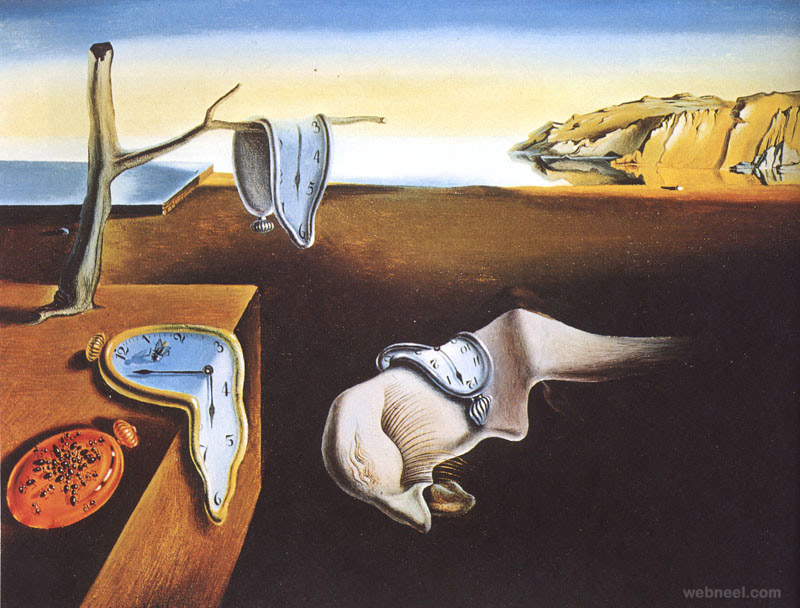
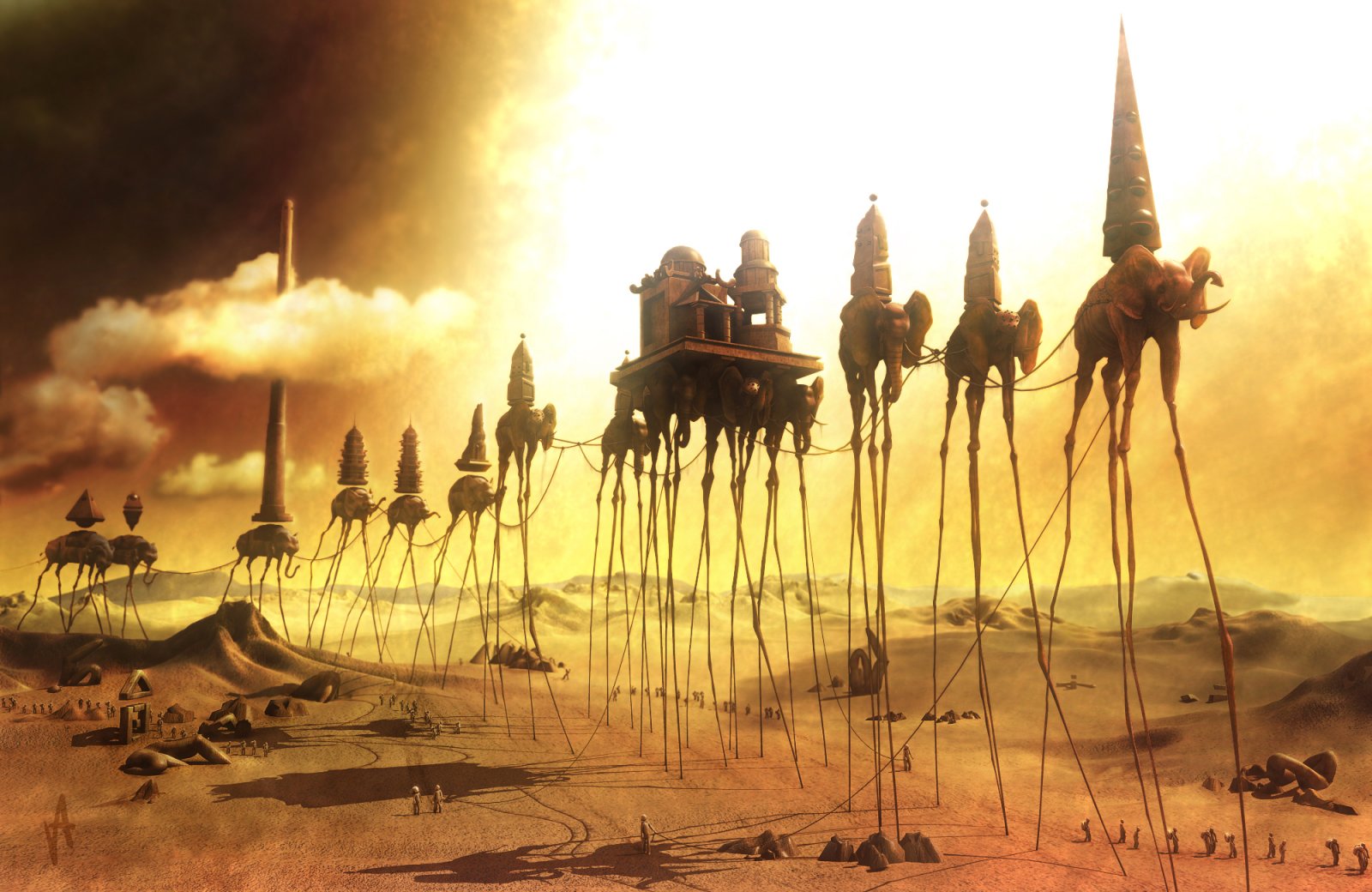
Artwork and Inspiration: The Work of Salvador Dalí
I enjoy surrealist artwork, and its capability to invoke the imagination beyond the realms of the everyday. Nicholas Roerich is one artist who I have previously discussed, accomplishing this internal provocation skilfully. One problem I identify with most role-playing game products and the artwork therein (my own included) is an adherence to safe genre tropes. A guy with a sword looks like a guy with a sword. When writing, surrealist artwork, particularly those pieces produced in the early 20th century, seem to violate my safe and well-worn boundaries, challenging me to consider something fresh. I think good artwork will do this: it requires a response. That can sometimes be uncomfortable to confront because a response is fairly inevitable. For instance, what do I do with the painting below?
I can either dismiss it as foolishness, I can accept it as a wonderfully imaginative piece, I can accept parts of it (like the concrete nature of the ship, but dismiss the fanciful aspects), or allow some other kind of response entirely. The point is, I have to respond. What's great about artwork is that it expresses something I may or may not have considered myself. And that is good. The artwork I will be discussing today is that of Salvador Dalí (1904-1989). His work, like the best artwork, demands an immediate response. But more so, it is transcendent of the laws and normalities of mundane existence. It is not "fantasy", but it is. A purpose of fantasy is to transport the consumer to other realities, to offer vision of possibilities not otherwise accessible, and to critique and explore the world around us (I could offer numerous citations for this, but I don't want to bore you). The reason D&D has been so popular since its inception is surely the phantasms it offers the participants. One is not bound by reality, thus there is a metaphysical and metaphorical transcendence to the whole affair. I don't want to get too wanky about the whole thing, but it can be powerful. A game can be impossibly funny, or it can be mind expanding, or it can be fucking boring, but I'm interested in the potential it offers the players. It is ritual at its best. Here's another of Dalí's:
I could place this scenario within a sandbox pretty easily. When I think of an encounter with a "statue" I do not think of this, though clearly I should! This would make an interesting encounter. Maybe this was once a giant, rent into pieces by a godling, turning to stone as the next morning dawned. This is creepy, but it's very interesting. Finding some moss covered westernised statue of a king is lame by comparison. I am literally stealing this idea as an encounter within a hex. I have to do a bit more work to determine what exactly happens, but maybe it is merely a point of interest.
The next piece, like the last, can only be described as fascinating. And, like the last, it is immediately applicable within a game.
Look how lovingly he tucks the inside bit/himself into bed! These things need to be in my game. Of course, if you're playing in a world filled with elves and dwarves and whatever, these may not fit (or they very much may). But I need them in my game. Read the facial characteristics of the subjects. The standing banana skin looks intelligent, considerate, and gentle, while the interior looks content and peaceful. How might these creatures reside in the world? What are their allegiances, and who are their enemies? It takes the idea of a banana hammock to another level (sorrynotsorry).
This next piece is a cross between a beholder and a mindflayer. This is probably the invention of a deranged wizard. Are the flaming giraffes a species? Maybe they are illusions or maybe they are the dreams of a dying god.
Finally, I will leave you with a few more pieces that have inspired me. The important thing, I suppose, is to be open to what the piece is saying. This is why I always try to remember and record my dreams. They are strange and (obviously) phantasmagorical; strange stuff happens, but it makes the best inspiration for interesting games.
Subscribe to:
Posts (Atom)