Showing posts with label Creativity. Show all posts

Friday, 2 October 2015

Artwork and Inspiration: The Work of Angela Deane

Continuing my (mini) series of inspirational artists, I would be remiss to not include the distinct aesthetic of Angela Deane's art. More specifically I want to discuss her "Ghost Photographs" collection. 


While unified by a common artistic theme, the notion is immediately applicable to role-playing games. There are a number of layers to the idea of the ghost within an everyday milieu. Ghosts are primarily invisible. Do people (in society) feel invisible? Ghosts are a remainder of something historical, dead, or representative of the past. Ghosts, by nature, seem to shun attention (at least explicit attention), yet Deane's ghosts almost revel in the exposure. 


They are, in essence, regular "people" going about their lives. It sort of begs the question as to whether non-ghosts can see the ghosts, but at least superficially, they are visible to us. Ghosts also represent "other", a repetitious theme in D&D. 


Regarding role-playing games, I mainly regard her work on two levels. The first is rather superficial or trite: How about a species of creatures (or actual ghosts), who have departed their bodies, yet are obviously in a liminal space between alive and dead. They are visible to living humanity, but they occupy a certain location within the world (geographically or metaphorically speaking). People know about them, and the players can interact with them. The second is more of a sociological concern: who are the "ghosts" within your setting? Are they obvious contenders like orcs, kobolds, half-orcs, whatever, or are they a particular subset of society who can add a level of political/socio-cultural nuance to your campaign? The latter (in my opinion) is more interesting. I'm inclined to combine the two ideas: a species of "ghost-like" creatures who are shunned, avoided, and loathed by society. They are visible to the naked eye, but  have been made "invisible" by the whim, and purposeful ignorance of the living. They are cursed to wander the earth seeking release. They might not even be aware they are dead. Maybe the PCs can help, maybe they cannot. Alternatively, they could be an interesting class or playable race. 


Personally, I like the everydayness of the series, and it highlights the idea that often inspiration is under our nose, waiting to be discovered.

Happy gaming. 

Thursday, 1 October 2015

Artwork and Inspiration: The Work of Salvador Dalí

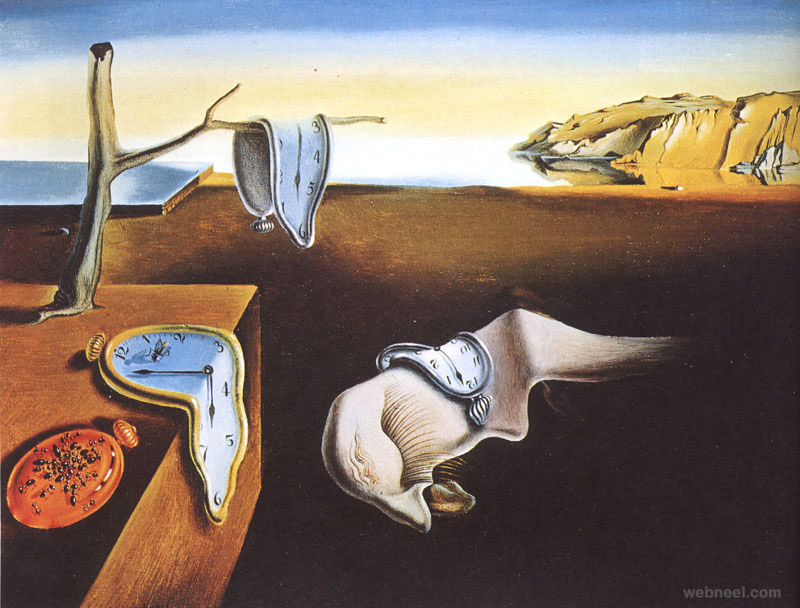
I enjoy surrealist artwork, and its capability to invoke the imagination beyond the realms of the everyday. Nicholas Roerich is one artist who I have previously discussed, accomplishing this internal provocation skilfully. One problem I identify with most role-playing game products and the artwork therein (my own included) is an adherence to safe genre tropes. A guy with a sword looks like a guy with a sword. When writing, surrealist artwork, particularly those pieces produced in the early 20th century, seem to violate my safe and well-worn boundaries, challenging me to consider something fresh. I think good artwork will do this: it requires a response. That can sometimes be uncomfortable to confront because a response is fairly inevitable. For instance, what do I do with the painting below?

Salvador Dali - Corey Ryan Walden

I can either dismiss it as foolishness, I can accept it as a wonderfully imaginative piece, I can accept parts of it (like the concrete nature of the ship, but dismiss the fanciful aspects), or allow some other kind of response entirely. The point is, I have to respond. What's great about artwork is that it expresses something I may or may not have considered myself. And that is good. The artwork I will be discussing today is that of Salvador Dalí (1904-1989). His work, like the best artwork, demands an immediate response. But more so, it is transcendent of the laws and normalities of mundane existence. It is not "fantasy", but it is. A purpose of fantasy is to transport the consumer to other realities, to offer vision of possibilities not otherwise accessible, and to critique and explore the world around us (I could offer numerous citations for this, but I don't want to bore you). The reason D&D has been so popular since its inception is surely the phantasms it offers the participants. One is not bound by reality, thus there is a metaphysical and metaphorical transcendence to the whole affair. I don't want to get too wanky about the whole thing, but it can be powerful. A game can be impossibly funny, or it can be mind expanding, or it can be fucking boring, but I'm interested in the potential it offers the players. It is ritual at its best. Here's another of Dalí's:

I could place this scenario within a sandbox pretty easily. When I think of an encounter with a "statue" I do not think of this, though clearly I should! This would make an interesting encounter. Maybe this was once a giant, rent into pieces by a godling, turning to stone as the next morning dawned. This is creepy, but it's very interesting. Finding some moss covered westernised statue of a king is lame by comparison. I am literally stealing this idea as an encounter within a hex. I have to do a bit more work to determine what exactly happens, but maybe it is merely a point of interest.

The next piece, like the last, can only be described as fascinating. And, like the last, it is immediately applicable within a game.

Look how lovingly he tucks the inside bit/himself into bed! These things need to be in my game. Of course, if you're playing in a world filled with elves and dwarves and whatever, these may not fit (or they very much may). But I need them in my game. Read the facial characteristics of the subjects. The standing banana skin looks intelligent, considerate, and gentle, while the interior looks content and peaceful. How might these creatures reside in the world? What are their allegiances, and who are their enemies? It takes the idea of a banana hammock to another level (sorrynotsorry). 

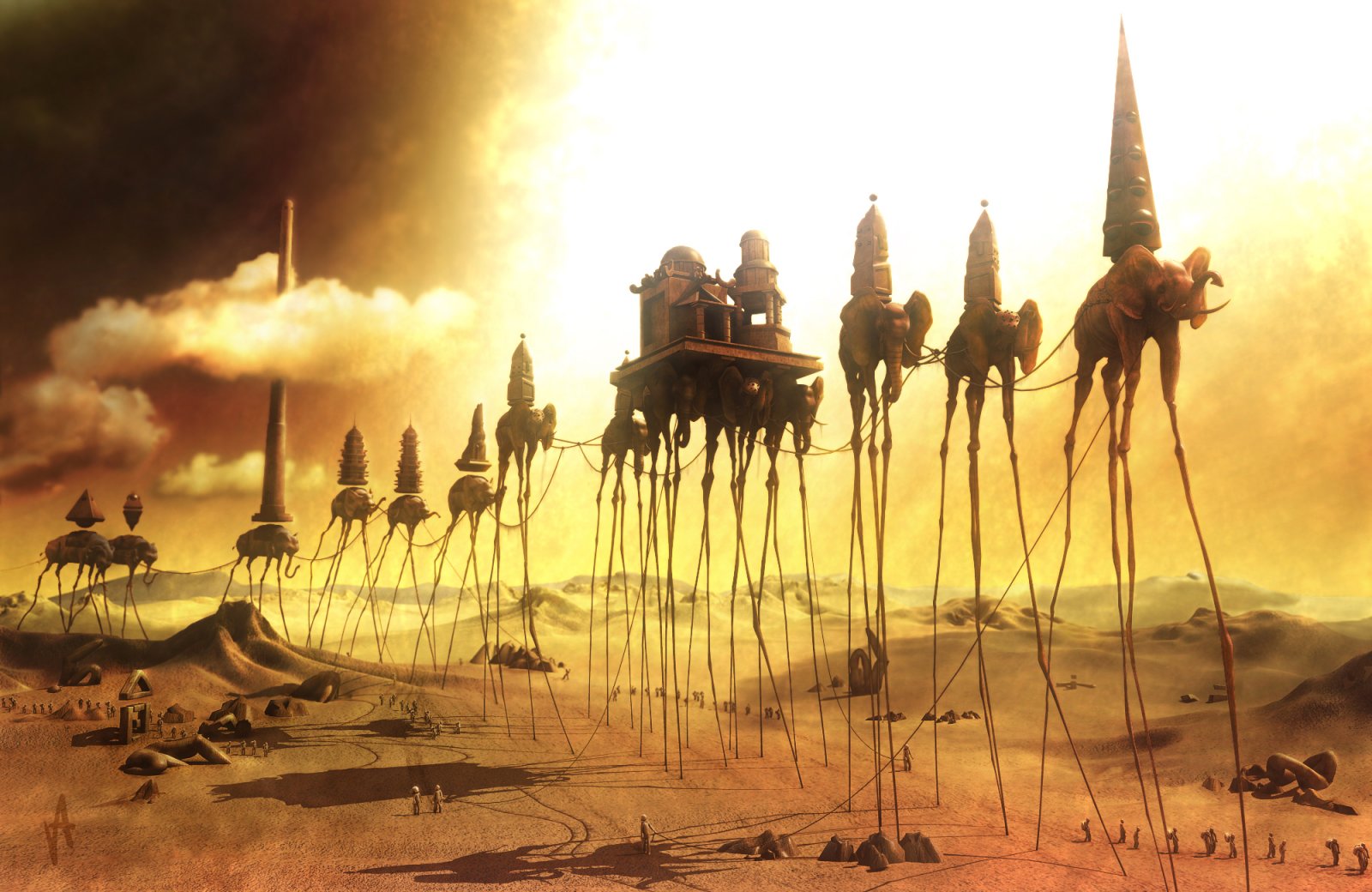
This next piece is a cross between a beholder and a mindflayer. This is probably the invention of a deranged wizard. Are the flaming giraffes a species? Maybe they are illusions or maybe they are the dreams of a dying god. 

Finally, I will leave you with a few more pieces that have inspired me. The important thing, I suppose, is to be open to what the piece is saying. This is why I always try to remember and record my dreams. They are strange and (obviously) phantasmagorical; strange stuff happens, but it makes the best inspiration for interesting games.


Thursday, 16 April 2015

Give a man a monster, and he'll game for one day; teach a man to create a monster, and he shall game forever.

My facetious take on an old proverb may be irreverent but it's true. I have in my collection tomes upon tomes, filled with monsters. My collection begins with the monsters presented in the 3 little brown booklets of Original Dungeons & Dragons. Add in the supplements like Greyhawk and Blackmooor and it's beginning to feel like Advanced Dungeons & Dragons. But why stop there? There is the Basic and Expert box set by Tom Moldvay and David Cook. There are real some goodies within, and of course we must not forget the aforementioned AD&D monster manuals. For good measure I also have the OSRIC rulebook and the Astonishing Swordsmen & Sorcerers of Hyperborea box set (both being representative of the content emerging from the OSR). Both of these present unique monsters, drawn from fandom or from the pages of Lovecraftian et al, tales. The 2nd edition Monstrous Manual sits next to them on my shelf, and again, is filled with a menagerie of options. I gave away my 3rd edition books some time ago, but again, we have similar monsters represented therein, and some different. I skipped 4th edition entirely, so cannot comment on that. Finally my 5th edition Monster Manual contains some of the classics we've all grown to love. I could throw in the adventures and other supplements I own: boxsets, modules, and my recently acquired Lamentations of the Flame Princess products (Carcosa, Isle of the Unknown, A Red & Pleasant Land). At this point you may be begging me to stop; and I shall.

These are all resources at my disposal, yet I'm inevitably drawn to my own imaginings when it comes to the various underworld (or wilderness) horrors appearing in my games. Don't get me wrong, I liberally borrow from the manuals I own, but when constructing my campaigns my position is always 'flavour first'. In many respects the system one plays is irrelevant, so long as it works for those at the table. The Internet is proof there is no definitive answer as to which system is inherently 'better'. Forums, blogs, websites, videos, and so on, are filled with nerd-raged fans proselytising the virtues of their edition of choice. At least it cannot be said of this subculture that we are passionless people. So play whatever you want, and be sure to have fun. The issue remains however, if whatever is being run is not working for you in your role as the DM. Nearly two years ago I started writing a Pathfinder campaign (which has concluded recently). My biggest frustration with that particular system was that it took so damn long to stat everything out. It interrupted my workflow and creativity. 'I would continue writing, but I need to work out NPC X's skill distribution'. Yeah. Not fun. Inevitably too, the flavour of the game was imposed by the ruleset I was using: I wanted a low magic, and somewhat underpowered campaign, yet mechanically and aesthetically this was a real stumbling block. In my opinion I ultimately failed in my mission, but you'd have to ask my players their opinion on the matter. Sure we had a good time, but it wasn't quite what I was attempting to achieve. The system got in the way.

The draw of simpler systems, whereby one can compose a stat block within 5 minutes has some real appeal in comparison. I can conceive of a monster, think 'damn that's awesome', and have it on paper within a very short duration. I can then continue my debased preparations, cackling occasionally as I scheme of the various horrors soon to be assailing my adventurers. Dungeons & Dragons from the outset, it seems to me, has always been about creativity and freedom. Creativity to conceive fantasy worlds of one's own devising, and to inhabit it with people and creatures. Imagine fiefdoms and baronies, or a race of alien overlords who enslave humanity for their own unknowable agendas. The geography is up for negotiation. Want a mountain here? Sure. This is a cave inhabited by men who farm giant worms? Sure. Even the physics and laws we must obey on Earth can be bypassed, manipulated or even ignored. Planets exist only as they're needed, or a campaign can exist purely within a flat-earth concept. Magic enables planar travel, invisibility and ultra-healing where in our world we say 'impossible!' The freedom within D&D, comes from exploring these worlds. A bank teller, an IT expert, a CEO and a taxi driver can set aside their 'mundane' identities for a few hours and be something they never were/are in reality, yet somehow represents them in an uncanny way.

Which brings me back to where we started: our rulebooks, our supplements, the products we purchase and the dice we use should be subservient to us. They are there to inspire, to motivate and enable our games as we envision them. They are not there to become a burden or a blockage to what we are trying to achieve. TSR's slogan used to be 'Products of your Imagination'. In other words, the system should disappear into the background, as your imagination gives birth to, and takes precedence over, your collective gaming experiences.

So go... Find a system that is effective in design and implementation, and enabling of the flexibility you need. Imagine those monsters, create those worlds, and you too shall game forever young grasshopper.